Thobe fabric quality is verified against six measurable numbers before a bulk order is placed: GSM within ±3 percent of the agreed weight, usable width, ends and picks per inch, shrinkage below 3 percent, a colour difference of ΔE ≤ 1.0 inside a lot and grey-scale Grade 4 or better between lots, and colour fastness of Grade 4 to washing, rubbing, light and perspiration. Everything a buyer can feel in the hand — softness, whiteness, the weight of the drape — sits on top of those six numbers, because hand feel is what any mill can imitate for a sample while the numbers are what a claim is argued from nine months later.
We have shipped thobe, kandura and djellaba cloth to Gulf wholesale markets for over a decade, and the disputes that cost money are almost never about the fibre. They are about shade, weight and shrinkage drifting between the sample a buyer approved and the containers that followed it.
The Short Answer: What Thobe Fabric Quality Really Means
Thobe fabric quality is conformance to a written specification that both sides can measure, not a subjective judgement of how premium the cloth feels in the hand.
Three failure modes cause most of the disputes we see between Gulf garment makers and their mills, and none of them is visible on the day the sample arrives:
- Shade drift between lots. The approved swatch is white; the bulk is a slightly different white. Nobody notices under office lighting, and everybody notices when six robes hang together in a shop window.
- Weight drift. A 135 GSM quality arrives at 122 GSM because a warp beam was stretched or a weft density was eased. The robe loses the body the buyer designed around.
- Shrinkage drift. The first wash takes 4 percent out of the length instead of 2 percent, and a 58-inch thobe becomes a 56-inch thobe on the customer.
Each of these is preventable with clauses that cost nothing to write and a sample protocol that costs one courier charge.
The Six Numbers to Write Into a Thobe Fabric PO
A thobe specification is only enforceable if the acceptance method is named next to the value. This is the table we recommend buyers attach to the enquiry, and it is the same table we quote against.
| Indicator | How it is measured | Tolerance we quote | What fails without it |
|---|---|---|---|
| Fabric weight | Cut-and-weigh per lot | ±3% on 120 GSM and above, ±5% below 120 GSM | Thinner drape, lighter robe, missing body |
| Usable width | Measured inside the selvedge | ±2 cm on 150 cm, no pinholes inside selvedge | Cutting yield drops, marker has to be redrawn |
| Ends × picks | Per inch, both directions | ±3% on the agreed construction | Air permeability and opacity shift |
| Shrinkage | ISO 6330, one wash cycle at 40 °C | ≤3% warp and weft on white and pale shades | Length loss after the first laundry |
| Colour difference | Spectrophotometer, D65, 45° | ΔE ≤ 1.0 within a lot, grey-scale ≥ 4 between lots | Visibly mismatched robes in one delivery |
| Colour fastness | ISO 105 series | Grade 4 wash, light and perspiration | Fading and staining complaints at retail |
If a supplier cannot name the test method behind a value, the value is a marketing phrase rather than a specification. Send us the specification you are running today and we will return it with the tolerance we hold for each line, so the acceptance criteria are visible before the price is.
Shade Consistency: The ΔE Ladder and the Grey Scale
Colour is the hardest thing to argue about and the easiest thing to measure, which is why shade belongs in the purchase order as numbers rather than as a description.
Two systems are used together in practice. The grey scale gives a visual grade for batch comparison, and the spectrophotometer gives a numerical difference in the CIELAB space. Buyers who rely on one alone are usually the buyers who end up arguing.
| ΔE reading | What the eye sees | Practical meaning for thobe fabric |
|---|---|---|
| 0 – 0.5 | Not detectable | Same dye lot, ideal for a single delivery |
| 0.5 – 1.5 | Detectable only side by side | Acceptable between production lots |
| 1.5 – 3.0 | Visible in daylight | Reject for white and pale shades |
| Above 3.0 | Obvious to any customer | Reject, and re-dip before production |
On white and off-white thobe fabric, most of the visible difference is a lightness shift rather than a hue shift. Record ΔL separately from the total ΔE, and hold CIE whiteness above 140 with an L* value at or above 93 for the white qualities used in Saudi and Emirati markets. A fabric can sit at ΔE 0.8 and still look wrong if all of that difference is on the lightness axis.
Measure under a D65 daylight light box with illumination at 45 degrees and the observer trained to look without tilting the sample, because sheen on a matte polyester changes the reading as the angle changes.
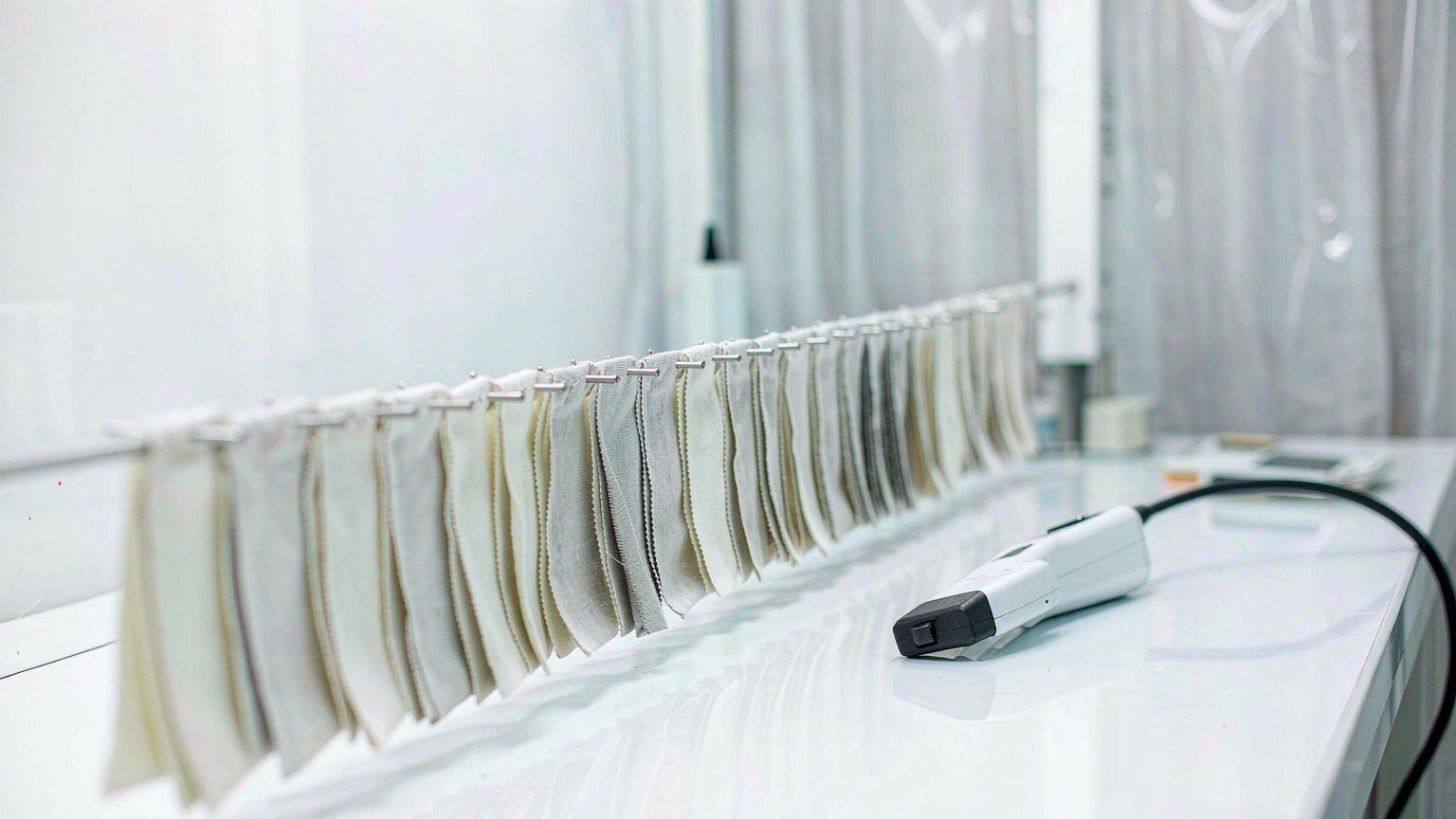
Whiteness grading is where shade control is won or lost on thobe cloth. A strip line built from every production lot, read against the same meter, turns a subjective argument about “which white is right” into a number that either passes or fails.
Colour Fastness: Four Tests and the Grades to Demand
A white thobe has to survive sun, sweat and repeated laundering, so four colour fastness tests belong on every acceptance sheet — not just the wash test that most mills quote by default.
| Test | Standard | Minimum grade | Why it matters for a thobe |
|---|---|---|---|
| Fastness to washing | ISO 105-C06 | Grade 4 | Laundry cycles in a domestic machine |
| Fastness to rubbing | ISO 105-X12 | Dry 4, wet 3–4 | Contact with the body and with seating |
| Fastness to light | ISO 105-B02 | Grade 4 | Years of outdoor wear under Gulf sun |
| Fastness to perspiration | ISO 105-E04 | Grade 4 | Neck, back and underarm contact |
Ask for the report from an accredited third-party laboratory rather than a mill self-test sheet. A full suite covering composition, GSM, shrinkage and the four fastness tests costs roughly $80–250 per quality and takes five to eight working days, which is small next to the cost of a rejected container. On any new finishing recipe, repeat the wash test at 5, 10 and 20 cycles: a quality that holds at one wash and drifts at twenty has a finishing problem that a single-cycle report will never show.
The same discipline applies to claims. OEKO-TEX STANDARD 100 covers the finished fabric for restricted substances, GRS covers recycled content, and from 27 September 2026 the EU’s Empowering Consumers Directive restricts unverified green claims in that market. If a supplier prints “eco-friendly” on a packing list without a certificate number, treat it as a phrase rather than a specification.
Physical Checks Most Buyers Skip
Weight, shrinkage, pH and seam behaviour are tested in under an hour and catch more production faults than any amount of visual inspection.
- Cut and weigh. A 10 × 10 cm die-cut sample on a 0.01 g scale, repeated at the head, middle and tail of every roll. This is the single fastest way to detect a stretched warp beam.
- Width, usable not cuttable. Selvedge with pinholes and a stiff edge is not usable width. Ask for both numbers.
- Shrinkage. ISO 6330 at 40 °C, warp and weft, on the white quality specifically, since white is bleached more aggressively and bleached cotton moves more.
- pH and formaldehyde. pH between 4.0 and 7.5 on the fabric as delivered; restricted substances within the limit of the destination market.
- Seam slippage. On tight plain and dobby constructions, a low weft density shows up as seam grinning in the finished robe rather than as a fabric defect.
- Whiteness after wash. Keep three swatches from every lot and wash one at 5 and one at 20 cycles against the unwashed control.
The 4-Point Inspection and What It Means for Fabric
Fabric is graded on a penalty-point system rather than on a single visual pass, and the acceptance ceiling should be written into the order before the first roll runs.
Under the widely used 4-point system, a roll is scored per 100 square yards for defects by size — 1 point up to 3 inches, 2 points from 3 to 6 inches, 3 points from 6 to 9 inches, and 4 points for anything larger or for a hole anywhere in the piece. First-quality woven apparel fabric normally sits at or below 20–28 points per 100 square yards, with no single defect above 4 points.
For white thobe fabric, add a specific defect list to the general score, because on white cloth the defects that matter are not the ones a general system weights heavily:
- Colour spots, oil marks and rust stains — reject, not downgrade.
- Broken ends, missing picks and reed marks — count as a run length, not as isolated points.
- Weft bars and start-up marks — the most common white-cloth complaint in bulk.
- Width variation inside a roll — measure at the head, middle and tail.
Inspection coverage matters too. A 10–20 percent random roll inspection is normal for dyed qualities; for white qualities destined for a single retail programme, inspect 100 percent of rolls and issue the report before shipment rather than after arrival.

Inspection is a labour cost as much as a quality tool, which is why the severity rules have to be agreed in writing before the run starts. If you would rather not build that programme from scratch, ask us for the acceptance sheet we use on white thobe qualities: it lists the defect definitions, the penalty ceiling per 100 square yards, and the test reports that ship with every lot.
Seal a Reference Swatch and Lock the Batch Number
The cheapest quality tool in the whole order is a 30 × 30 cm swatch cut from the approved sample, signed by both parties, sealed, and stored with the purchase order number written on the bag.
Every dispute we have resolved came back to one of two questions: which sample was approved, and which lot was shipped. Two clauses close both questions:
- Repeat orders must ship from the same batch number as the approved lot. If the batch number changes, the supplier must notify the buyer in writing before production and submit a new reference swatch for confirmation.
- Any supplementary order placed within twelve months must match the sealed reference swatch on shade, weight and hand feel, measured with the methods listed in this specification.
A mill that resists either clause is telling you that its lot control is not strong enough to hold a shade across two orders. That is worth knowing before a deposit, not after.
Documents to Demand Before the Deposit
| Document | What it proves | Typical cost and lead time |
|---|---|---|
| Third-party test report | Composition, GSM, shrinkage, four fastness tests | $80–250 per quality, 5–8 working days |
| Cut-and-weigh record | Per-lot weight against the specification | Free, issued with the lot |
| Composition certificate | Polyester, viscose and cotton ratio as ordered | Free on request |
| OEKO-TEX STANDARD 100 | Restricted substances on the finished fabric | Certificate copy, mill-held |
| GRS or RCS certificate | Recycled content, on recycled qualities only | Certificate plus transaction certificate |
| Sealed reference swatch | The physical standard for the whole order | One courier charge |
Two Buyers Who Rewrote Their Acceptance Terms
A Jeddah garment maker used to approve thobe fabric on hand feel alone. Three seasons in a row, robes from different production weeks showed a visible shade difference under shop lighting, and the returns came back to the garment maker rather than to the mill because nothing in the order quantified shade. Writing ΔE ≤ 1.0 and grey-scale Grade 4 into the PO, plus a sealed swatch protocol, ended the cycle in one season.
A Dubai importer had a 135 GSM white quality arrive at 122 GSM across two containers. The fabric looked correct on a hanger and failed on the body of the robe. Adding a cut-and-weigh record per lot to the shipping documents, with the tolerance written as a range, gave the importer a measurable basis for a claim and gave the mill a reason to check the loom settings before running the beam.
Four Steps From Specification to Bulk
- Choose the quality and agree the specification. Fibre blend, GSM, weave, width, whiteness and the acceptance methods, all in one document. Our quality and price tier comparison shows what each price band delivers in specification terms.
- Order samples and approve a physical standard. Sample orders run from lab dips in three to five days to full-width yardage, and the approved piece becomes the sealed reference swatch.
- Confirm the acceptance criteria and lock the lot. Test report, cut-and-weigh record, batch number and the repeat-order clause.
- Produce, inspect and ship. 4-point inspection report issued before loading, documents sent with the bill of lading copy.
If you are comparing Chinese mills with local Gulf suppliers and want the trade-offs side by side, our UAE and Dubai sourcing comparison covers cost, lead time and inspection access.
We quote thobe, kandura and djellaba cloth with the acceptance criteria written next to the price — GSM tolerance, shrinkage limit, ΔE ceiling, whiteness value and the test report you will receive — so the specification and the quote arrive as one document. Tell us the quality you are running today and the market it is going to, and we will return a tolerance sheet you can attach to your own purchase order unchanged. Send your specification through our RFQ form, or message us on WhatsApp with the GSM and shade you need and we will confirm what we can hold at your volume.
Frequently Asked Questions
How do buyers check thobe fabric quality before placing a bulk order?
Thobe fabric quality is checked in three stages. First, against the specification: GSM cut and weighed within plus or minus 3 to 5 percent, usable width, ends and picks per inch, and shrinkage under 3 percent after an ISO 6330 wash. Second, against a sealed reference swatch cut from the approved sample and signed by both parties. Third, against third-party test reports for colour fastness under ISO 105 and, on white qualities, a CIE whiteness reading above 140. A buyer who only judges the hand feel of a sample has checked nothing that survives bulk production.
What GSM tolerance should a thobe fabric order allow?
A reasonable tolerance for thobe fabric is plus or minus 3 percent on an agreed GSM, and no more than 5 percent on lighter qualities below 120 GSM where the same absolute deviation is a larger share of the total. A 135 GSM thobe quality arriving at 122 GSM is outside any defensible tolerance and will drape visibly thinner than the approved sample. Write the tolerance as a range in the purchase order, ask for a cut-and-weigh result from every production lot, and keep the cream or grey sample of each lot so a drift across several shipments can be proved later.
What colour difference is acceptable between thobe fabric batches?
For white and pale thobe fabric, hold batch-to-batch colour difference to a grey-scale grade of 4 or better and an instrument reading of delta E at or below 1.0. Inside a single roll, side-to-centre and head-to-tail should reach grade 4 to 5. Delta E between 1.5 and 3.0 is visible when two robes hang side by side in daylight, and above 3.0 it is obvious to a customer. Measure under a D65 light box with 45 degree illumination rather than in office lighting, and record delta L separately, because on white fabric most of the visible difference is a lightness shift rather than a shift in hue.
Which colour fastness grades should a white thobe fabric meet?
Demand Grade 4 colour change on washing to ISO 105-C06, Grade 4 dry rub and Grade 3 to 4 wet rub to ISO 105-X12, Grade 4 to light to ISO 105-B02, and Grade 4 to perspiration to ISO 105-E04. Light fastness matters more in the Gulf than in most markets because a thobe is worn outdoors under strong sun for years, and perspiration fastness matters because a robe contacts the skin at the neck, back and underarms. Ask for reports from an accredited third-party laboratory rather than the mill self-test sheet, and repeat the wash test after 5, 10 and 20 cycles on any new finishing recipe.
What documents should a thobe fabric supplier provide with the shipment?
Ask for five documents with every bulk shipment: a third-party test report covering composition, GSM, shrinkage and the four colour fastness tests; a GSM or cut-and-weigh record per production lot; the composition certificate confirming the polyester, viscose or cotton ratio you ordered; a certificate for any claim printed on the packing list, such as OEKO-TEX STANDARD 100 or GRS on recycled qualities; and the lot or batch number matching the sealed reference swatch. Where a supplier cannot match the batch number on a repeat order, the order should be treated as a new quality and re-sampled before production.