Thobe fabric price per meter runs from about $0.76 for entry-level plain polyester to $5.00 for yarn dyed jacquard, and the gap is set by five spec lines you can write down: yarn quality, finished GSM, weave, finishing route and batch consistency. We have exported thobe, kandura and djellaba cloth to the Gulf for ten years, and the same conversation repeats every season — two quotes arrive for “white thobe fabric”, one at $0.88 and one at $1.45, and nobody can say which is the better buy because neither quote names a specification. This article prices each tier line by line, then gives you the twelve-line comparison sheet we use with our own buyers so that quotes become comparable.
If you want the construction side of the same question first, our thobe fabric GSM and weight guide explains how weight bands map to seasons, and the thobe fabric wholesale price guide covers whole-roll economics and container loading.
The Short Answer: Thobe Fabric Price per Meter by Tier
Four tiers cover nearly every thobe programme we quote: entry plain polyester at $0.76 to $1.05 per meter, mid-tier TR and TC at $1.10 to $1.70, upper-mid fine-dtex micro and dobby at $1.80 to $2.60, and premium jacquard and yarn dyed at $2.60 to $5.00.
| Tier | Price band (FOB) | Composition | Finished GSM | Yarn | Weave and finish | Typical programme | The risk you carry |
|---|---|---|---|---|---|---|---|
| Entry | $0.76-1.05 | 100% polyester | 120-140 | 68-75 dtex filament, or 45s single | Plain, bright lustre finish | Volume white thobes, promotional lines, uniform top-ups | Lustre reads cheap in strong sun, shrinkage up to 4%, shade drift between lots |
| Mid | $1.10-1.70 | TR 65/35, TC 60/40 | 130-160 | 45s-60s single | Plain or 2/1 twill, soft or BS finish | Wholesale white thobe, Ramadan volume, hotel and corporate cloth | Over-softening flattens the cloth, and hand varies lot to lot when finishing is outsourced |
| Upper-mid | $1.80-2.60 | Fine-dtex micro polyester, finer TC | 130-155 | 60s-80s | Micro-dobby, delustred matte | Premium retail thobe, brand programmes | Matte depth shifts if delustrant dosing is not fixed per lot |
| Premium | $2.60-5.00 | Micro filament, TR jacquard, yarn dyed | 150-220 | 80s-120s two-ply | Dobby, jacquard, yarn dyed stripe | Designer thobe, self-patterned kandura, winter weights | Loom setup per design, and 300 to 600 picks per minute means higher minimums |
Read the table as a purchasing ladder, not a quality ranking. A wholesale programme selling into a price-sensitive market is correctly served by the entry tier, provided the shrinkage and fastness lines are locked. A brand programme that will be photographed under Riyadh daylight is not.
Why the Same Thobe Cloth Costs Four Times as Much
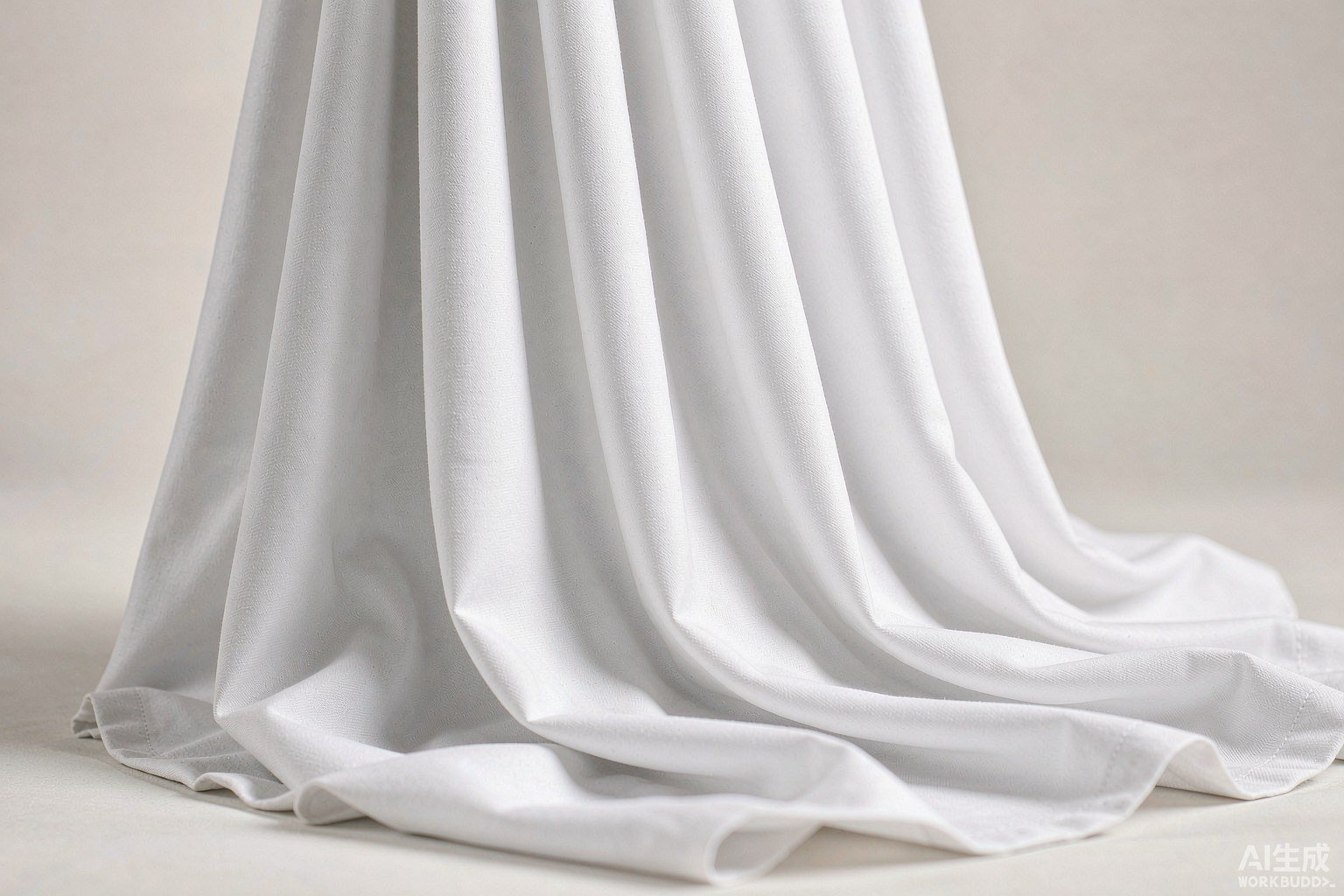
Roughly 42 to 55 percent of a thobe fabric price is greige yarn, 12 to 18 percent is weaving, 15 to 25 percent is dyeing and finishing, and the remaining 8 to 14 percent is inspection, packing, overhead and mill margin — so no supplier can sell a premium construction at an entry price.
| Cost line | Share of FOB price | What moves it |
|---|---|---|
| Greige yarn | 42-55% | Polyester filament and cotton index, yarn count, whether the yarn is two-ply |
| Weaving | 12-18% | Picks per minute: 700-900 on plain looms, 300-600 on dobby and jacquard |
| Dyeing and finishing | 15-25% | Soft finish, delustering, sanforising, brushing and anti-static are separate lines |
| Inspection and packing | 2-4% | Four-point inspection plus roll packing at $0.06-0.10 per meter |
| Overhead and margin | 8-14% | Compresses as volume rises, which is why MOQ affects price |
The yarn line is the one buyers underestimate. Moving from a 45s single yarn to an 80s two-ply raises yarn cost in the region of 30 to 45 percent before anything reaches the loom, and that increase is visible in the meter price no matter how efficient the mill is. Equally, the cheapest way to hit a price target is to drop finished GSM, which is why a quote without a weight figure is not a quote at all.
Entry Tier: What $0.76 to $1.05 per Meter Buys
The entry tier is bright-finish plain polyester at 120 to 140 GSM, and it is a legitimate product for high-volume white thobe programmes as long as shrinkage, whiteness and defect allowance are specified.
- Composition. 100% polyester, typically 68 to 75 dtex filament, occasionally blended with a small viscose content to soften the hand.
- Construction. Plain weave, 45s to 50s equivalent yarn, 110 to 130 ends and picks per inch.
- Finish. Optical brightened and calendered for a bright, slightly reflective surface.
- Test lines to fix. Shrinkage 4 percent maximum after three washes, colour fastness to rubbing grade 3 to 4, whiteness value declared on the finished cloth rather than greige.
- Where it fails. Under Gulf daylight a high lustre reads as a cheap cloth, and a 4 percent shrinkage allowance costs you usable width after the first wash.
We quote this tier most often for promotional white thobes and for buyers who need to hit a landed cost per garment rather than a fabric aesthetic. When a buyer tells us the garment must survive a weekly wash cycle for two years, we move them up one tier rather than discount further.
Mid Tier: What $1.10 to $1.70 per Meter Buys
The mid tier is TR or TC plain and soft-finished cloth at 130 to 160 GSM, and it is where most Gulf wholesale and Ramadan volume sits because it balances matte appearance with a price that still works at volume.
Three things change from the entry tier:
- Fibre blend. TR at 65/35 or TC at 60/40 gives a matte surface with better moisture behaviour than pure polyester in summer heat.
- Yarn count. 45s to 60s single yarn tightens the weave and improves drape, which is what makes a thobe hang instead of standing away from the body.
- Finishing route. Soft finish, sanforising or a light brushing step, each priced separately and each changing the hand.
One caution we give every buyer at this tier: soft finishing is a spectrum, and over-softening reduces the definition of any surface texture by 30 to 40 percent. If a programme carries a self-stripe or a fine dobby line, specify the finish against a reference swatch and confirm it on the bulk lot, not just the development lot.
If you are holding two mid-tier quotes and cannot separate them, send both specifications to us and we will price the same cloth on the same terms. Request a thobe fabric quotation with your target GSM, width and finishing route and we will return a written price with the comparison lines filled in.
Premium Tier: What $1.80 to $5.00 per Meter Buys
Above roughly $1.80 per meter you are buying finer yarn and a more complex weave, not just a better finish: fine-dtex micro filament, micro-dobby, jacquard and yarn dyed qualities, at 150 to 220 GSM.
What that money changes, in order of what buyers notice:
- Light behaviour. Delustred matte surfaces scatter light instead of reflecting it, so the cloth keeps an even tone as the wearer moves and does not show the sheen that marks entry-tier polyester.
- Surface structure. Dobby and jacquard lines are woven in rather than printed, so a self-pattern survives washing and does not need registration control at the cutting stage.
- Yarn quality. 80s to 120s two-ply yarn produces a denser, smoother cloth with a lower hairiness count, which reduces pilling and improves print and embroidery definition.
- Consistency engineering. At this tier we fix whiteness above CIE 140 at 50 washes, shrinkage within plus or minus 2 percent, and batch-to-batch colour difference under 1.0 Delta E, all verified on the finished cloth.
Two costs arrive with the premium tier and buyers should plan for both. Loom setup runs $400 to $900 per design because a jacquard harness must be built, and weaving speed drops to 300 to 600 picks per minute against 700 to 900 on a plain loom, which raises the minimum order needed to justify a run.
Comparing Quotes Like-for-Like: The Twelve Lines
Two thobe fabric quotes are only comparable when all twelve of these lines match; without them a 60 percent price gap can mean either a different cloth or a different set of promises.
| Line | What to require in writing |
|---|---|
| Composition | Fibre percentages with tolerance, and whether the blend is nominal or guaranteed |
| Finished GSM | Weight after finishing, with the tolerance, not the greige figure |
| Width | Cuttable width in centimeters, and the usable width after shrinkage |
| Yarn count | Count and whether the yarn is single or two-ply |
| Weave | Plain, twill, dobby or jacquard, with the repeat size |
| Finish | Each step named: soft, matte, sanforised, brushed, anti-static |
| Shrinkage | Test method and result, for example 3 percent maximum after three washes |
| Colour fastness | Standard and grade for rubbing and for washing |
| Whiteness | Declared value on finished cloth, and the retention after 50 washes |
| Defects | Four-point allowance in points per 100 square yards |
| Packing | Roll length, inner bag, outer wrap, and packing cost per meter |
| Commercials | Price basis, MOQ per colour, lead time, payment terms |
The single most useful habit here is ordering a production-matched sample taken from the same warp and dye lot as the bulk. A showroom reference sample is often hand-finished, and the difference between a reference and a production run is exactly where shade and hand complaints begin.
The Cost Lines That Sit Outside the Price per Meter
Four charges are billed once per order rather than per meter, and a buyer comparing meter prices alone will be surprised by all four: lab dips, loom setup, packing and inspection extras.
- Lab dips. $30 to $80 per colour per round, and two rounds are normal when a shade is matched against a physical standard.
- Loom setup. $400 to $900 per design on dobby and jacquard qualities, absorbed above roughly 3,000 meters.
- Packing. $0.06 to $0.10 per meter for standard roll packing; export pallets and protective film are quoted separately.
- Testing. Third-party test reports are charged per test per submission, and they are worth budgeting for one combined submission rather than several.
Payment terms also change the effective price. Our standard terms are 30 percent T/T deposit with the balance against the bill of lading copy, or an irrevocable L/C at sight above $40,000, and L/C charges should be measured against the discount a supplier may offer for cheaper terms.
Buying at the Right Point in the Season
Gulf thobe demand peaks before Ramadan and Eid, and fabric is booked two to three months ahead of the garment sewing date, so the cheapest meter price and the right delivery window rarely arrive in the same month.
With Ramadan 2027 beginning in early February, the practical calendar for a Ramadan delivery looks like this:
- August to September. Development: shade standards, finishing references and first lab dips confirmed.
- October to November. Bulk booking, when loom time is still available and the cheap yarn positions are open.
- December to January. Production and shipment, with freight capacity tightening.
- From January. Spot buying, where the price premium and the schedule risk both sit.
Our own pricing shows an 8 to 15 percent band between the quiet months and peak months for the same quality. A buyer who locks the construction in October and ships in December pays less than one who negotiates in January for the same cloth.
Two Buyer Cases: A Jeddah Factory and a Kuwait Wholesaler
Both cases came to us with a price problem and left with a specification problem, which is the usual shape of a thobe fabric negotiation.
The first was a garment factory in Jeddah running corporate white thobes for a services group. Their incumbent cloth was quoted at $0.79 per meter, and every third lot failed an internal wash check. We moved them to a mid-tier TR cloth at $1.28 with shrinkage capped at 2.5 percent and whiteness declared on finished cloth. The meter price rose by 62 percent, and the claim rate against finished garments fell far enough that the landed cost per accepted shirt came down.
The second was a wholesale trader in Kuwait buying five qualities for the Ramadan season on the lowest quote each time. Shade drift between lots created mixed shade stacks in the warehouse, and two qualities had to be discounted. We put all five qualities on the same twelve-line sheet, moved four of them to a single mill with fixed finishing parameters, and kept one entry-tier quality for the price-sensitive end of their range.
Sourcing Thobe Cloth at a Known Tier
We quote thobe, kandura and djellaba cloth by tier with the specification attached, so the price per meter arrives with the GSM, weave, finish and test lines already named.
| Item | Specification | Price (FOB Ningbo or Shanghai) | MOQ |
|---|---|---|---|
| Entry plain polyester | 120-140 GSM, bright finish | $0.76-1.05 / m | 500-1,000 m per colour |
| TR and TC plain | 130-160 GSM, soft or BS finish | $1.10-1.70 / m | 500-1,000 m per colour |
| Micro-dobby, matte | 130-155 GSM, delustred | $1.80-2.60 / m | 1,000-2,000 m per colour |
| Jacquard and yarn dyed | 150-220 GSM, self-patterned | $2.60-5.00 / m | 1,000-3,000 m per colour |
| Sampling | Free swatch pack, courier paid by buyer | Lab dips $30-80 each | – |
| Lead time | Stock shades 15-30 days | Custom 30-45 days | – |
Tell us the tier you are buying for and the garment price you need to hit, and we will say plainly which specification can reach it. Send your target price and season date through our RFQ form, or message us on WhatsApp with the quality you are running now and we will price the same cloth — and the tier above it — so you can see what the extra money actually buys.
Frequently Asked Questions
What is a fair price per meter for thobe fabric?
For white thobe cloth bought FOB Ningbo or Shanghai in 2026, a fair price is roughly 0.76 to 1.05 US dollars per meter for entry-level plain polyester at 120 to 140 GSM, 1.10 to 1.70 dollars for TR or TC plain and soft-finished qualities at 130 to 160 GSM, and 1.80 to 5.00 dollars for fine-dtex micro, dobby, jacquard and yarn dyed qualities. A quote far below the entry band usually means lighter GSM, a coarser yarn count or a finishing route that has been left out, so the right question is never which price is lowest but which specification is being priced.
Why does thobe fabric price vary so much between suppliers?
The spread comes from five spec lines: yarn quality and count, finished GSM, weave structure, finishing route and batch consistency. Roughly 42 to 55 percent of a thobe fabric price is greige yarn, 12 to 18 percent is weaving, and 15 to 25 percent is dyeing and finishing, so a change in any one of those lines moves the meter price. Suppliers also quote different bases. A price with no finishing line, ex-works, in a single shade, at a wide GSM tolerance is not the same offer as a soft-finished, four-point inspected, FOB price, even when the two numbers sit 40 percent apart on the page.
How much does thobe fabric cost per meter in bulk?
Volume moves the price through weaving efficiency and dye-lot size rather than through the yarn itself. Stock shades start at 500 to 1,000 meters per colour, and custom construction from around 3,000 meters per quality, where the loom setup is absorbed. On a 20,000 meter plain white order we typically land 6 to 12 percent below the same quality at 3,000 meters, and a full 40HQ of 42,000 to 52,000 meters can hold another 3 to 5 percent. Custom dyeing, lab dips at 30 to 80 dollars each and loom setup at 400 to 900 dollars per design are charged once per order, not per meter.
How do I compare thobe fabric quotes fairly?
Put the same twelve lines on every request: composition with tolerance, finished GSM, width in centimeters, yarn count, weave, finishing route, shrinkage method and result, colour fastness standard and grade, whiteness value, defect allowance, packing, and price basis including MOQ, lead time and payment terms. Then ask for a production-matched sample from the same warp and dye lot, not a showroom reference. Two quotes can differ by 60 percent and still be the same value once the specification is written down, and two quotes that look identical on price can hide a 15 percent difference in usable width after shrinkage.