Wrinkle free thobe fabric is not one product but three: a thermoplastic fibre such as heat-set polyester that springs back because of its molecular structure, a resin finish that cross-links cellulose so cotton stops holding a crease, and a denser, higher-twist construction that simply resists bending in the first place. Which route a buyer selects decides the price, the hand feel, the breathability and how long the no-iron promise survives real wear. A resin-finished cotton thobe that grades perfectly smooth on the first swatch can lose 20 to 40 percent of that recovery by the fiftieth wash, while a correctly heat-set polyester thobe never had a finish to lose.
We have exported thobe, kandura and djellaba fabric to Gulf wholesalers, garment makers and retail brands for more than ten years. The crease complaints that reach us are almost never about fibre, and almost always about a specification that said “wrinkle free” without naming which of the three routes was meant, or which test would prove it.
The Short Answer: Wrinkle Free Thobe Fabric Comes From Three Different Routes
Wrinkle free thobe fabric is produced either by thermoplastic heat setting on polyester and TR blends, by resin cross-linking on cotton and cellulose blends, or by physical construction — and only the heat-setting route is permanent. The three routes are not equivalents, and they are not priced as equivalents.
| Route | How it works | Crease recovery angle (warp + weft) | Durability of the effect | Effect on hand | Cost adder |
|---|---|---|---|---|---|
| Heat-set 100% polyester | Thermoplastic fibre fixed under tension at 180–210 °C | 260–300° | Permanent; survives 50+ washes | Soft to crisp depending on finish | None to $0.15/m |
| Heat-set TR (65/35 polyester-rayon) | Same mechanism, rayon softens the hand | 240–280° | Permanent, slightly less than pure poly | Softer, more drape | None to $0.20/m |
| Resin-finished cotton-rich (TC) | Cross-links cellulose, restricting hydrogen-bond slip | 190–230° | Declines 20–40% over repeated laundering | Firmer, less soft | $0.12–0.30/m |
| Untreated 100% cotton | No mechanism; fibres slip and re-bond in the crease | 130–170° | Does not improve with wear | Very soft | Baseline |
The single most useful number in the table is the crease recovery angle, because it is measurable and it survives an argument. Ask for it in writing on the swatch submission.
Why Fabric Creases At All
Creasing is hydrogen bonding in cellulose and plastic deformation in synthetics, which is why the same crease problem needs two different answers.
In cotton and other cellulose fibres, water molecules and mechanical pressure let polymer chains slide past one another, then re-bond in the new position as the fabric dries. The crease is not a broken fibre, it is a rearranged one. This is why cotton thobes crease most where a body presses and perspires — at the lap, the elbows and the back of the knee — and why pressing with steam removes the crease without any chemistry.
Polyester behaves differently. Below its glass transition temperature it holds whatever shape it was heat-set into, but under sustained compression with heat and moisture the structure relaxes and takes on the new form. That is the mechanism behind a set of creases that appear after two hours of sitting, and it is also why steam releases them. Nothing is damaged; the shape memory simply needs to be reset.
The Three Routes, in Production Terms
Each route is executed at a different stage of production, which is why they carry different lead times, different risks and different minimums.
Heat setting. The grey fabric is scoured, then passed through a stenter at 180 to 210 °C with controlled overfeed and width. The temperature range is set by the yarn denier and the finish: too low and the fabric creeps in the first wash, too high and the polyester takes on a harsh, papery hand or a permanent shine. Running speed is typically 20 to 40 m/min, and width stability is one of the outputs you should be able to measure — a good heat-set quality should hold width within ±2 percent after five washes to ISO 6330.
Resin finishing. A cross-linking agent is padded onto cellulose fabric, dried, then cured at 150 to 165 °C. DMDHEU remains the workhorse; low-formaldehyde and formaldehyde-free polycarboxylic acid systems cost more and generally deliver slightly lower recovery. Two side effects have to be managed. Tear strength typically drops 20 to 40 percent and tensile strength 10 to 25 percent, and moisture regain falls, so the fabric feels drier and slightly warmer against the skin. On white cloth, curing at the top of the temperature window raises the risk of yellowing, which is why a white resin-finished thobe should be specified with an L* value and a CIE whiteness target alongside the crease angle.
Construction. A denser weave, a higher picks-per-inch count or a higher twist yarn resists bending without any chemistry. The cost is stiffness and weight, and usually a narrower comfortable GSM window. It is a useful second line of defence rather than a standalone answer.
What Wrinkle Free Actually Costs You Elsewhere
Recovery performance is bought with strength, softness or breathability, and a buyer who specifies only the recovery number will be surprised by one of the other three.
- Tear strength. Resin finishing is the most expensive route here: 20 to 40 percent loss in the warp direction is common. On a thobe that is worn daily and laundered industrially, this is the specification that decides garment life.
- Air permeability. Calendering and dense construction both cut airflow. Measured to ISO 9237, a light 118 GSM plain polyester runs 240 to 420 mm/s, and a comparable cloth that has been heavily calendered for a smooth, flat look can lose around 40 percent of that. In Gulf summer heat, buyers feel the difference.
- Hand feel. Resin makes cellulose firmer. A buyer comparing a resin-finished TC swatch to an untreated one of the same GSM will describe the treated cloth as “papery” unless it has been softened in the same bath.
- Formaldehyde. Any resin route requires a declared limit. ISO 14184-1 or AATCC 112 is the test, and the OEKO-TEX Standard 100 limit values are 16 ppm for Class I and 75 ppm for Class II. Our own resin qualities are supplied with the test report attached.
- Price. Expect $0.12 to $0.30 per metre for a resin finish and nothing to $0.20 for heat setting, on top of the base quality. Against the $0.76 to $1.80 band our plain thobe qualities occupy, that adder is visible on a 10,000 metre programme.
Wash Durability: The Number Most Buyers Never Ask For
The recovery measured on a factory-fresh swatch is the number that gets quoted, and the recovery after fifty washes is the number that matters.
| Quality | Fresh crease recovery | After 20 washes (ISO 6330, 40 °C) | After 50 washes | Why it changes |
|---|---|---|---|---|
| Heat-set 100% polyester, 118 GSM | 260–300° | 255–295° | 250–290° | Fibre property; nothing to abrade |
| Heat-set TR 65/35 | 240–280° | 230–270° | 220–260° | Rayon fraction relaxes first |
| Resin cotton-rich TC 65/35 | 190–230° | 165–200° | 140–180° | Finish abrades and hydrolyses |
| Resin-finish free cotton (formaldehyde-free) | 175–215° | 140–175° | 115–150° | Lower bond density to begin with |
| Untreated 100% cotton | 130–170° | 125–165° | 120–160° | No finish present at any stage |
A buyer ordering for a corporate programme or a hotel or airline uniform, where garments are laundered fifty or more times, should treat the fifty-wash column as the honest specification and ask for the test rather than accepting the fresh figure.
How to Test Before You Commit to Bulk
Three tests, in ascending order of how closely they match the customer complaint, and all three fit inside one sampling round.
- Crease recovery angle on the swatch. Measured to AATCC 66 or ISO 2313, reported in degrees for warp and weft. This is a mill-floor test and it should come back within five working days.
- Smoothness appearance after laundering. Five cycles to ISO 6330 at 40 °C, then grade against ISO 7768 or AATCC 124 replication standards, SA-1 to SA-5. Ask for photographs of the graded specimens, not a written pass.
- The sitting test. Sew the fabric into a garment, wear it seated for two hours, then photograph the lap under D65 light next to the unused garment. It is unscientific and it is the closest thing to what a retail customer will actually see.
Add one further check before bulk: measure the GSM, the width and the CIE whiteness after those five wash cycles rather than before. A wrinkle-free quality that shrinks 4 percent or drops from L 94 to L 91 is a returns problem disguised as a finishing win.
The Spec to Write on the Purchase Order
A wrinkle-free requirement becomes enforceable only when the route, the test method and the acceptance value are all named.
| Line | What to specify | Typical value |
|---|---|---|
| Composition and quality name | Fibre content, yarn count, weave | 100% polyester, 48×48, plain |
| GSM | Measured to ISO 3801, after wash | 118 GSM ±3% |
| Width | Cut width and usable width | 150 cm, ±2% after 5 washes |
| Crease route | Heat set, resin, or construction | Heat set at 190–200 °C |
| Crease recovery | AATCC 66 or ISO 2313, warp + weft | ≥ 260° |
| Smoothness after wash | ISO 7768 / AATCC 124 grade | ≥ SA-4 at 5 and 20 cycles |
| Whiteness (white qualities) | L* and CIE whiteness | L* ≥ 93, CIE > 140 |
| Air permeability | ISO 9237 | ≥ 240 mm/s |
| Shrinkage | ISO 6330, 40 °C, 3 cycles | ≤ 3% |
| Colour fastness | ISO 105-C06, ISO 105-X12, ISO 105-B02 | Grade 4 minimum |
| Free formaldehyde (resin grades only) | ISO 14184-1 / AATCC 112 | ≤ 75 ppm (Class II) |
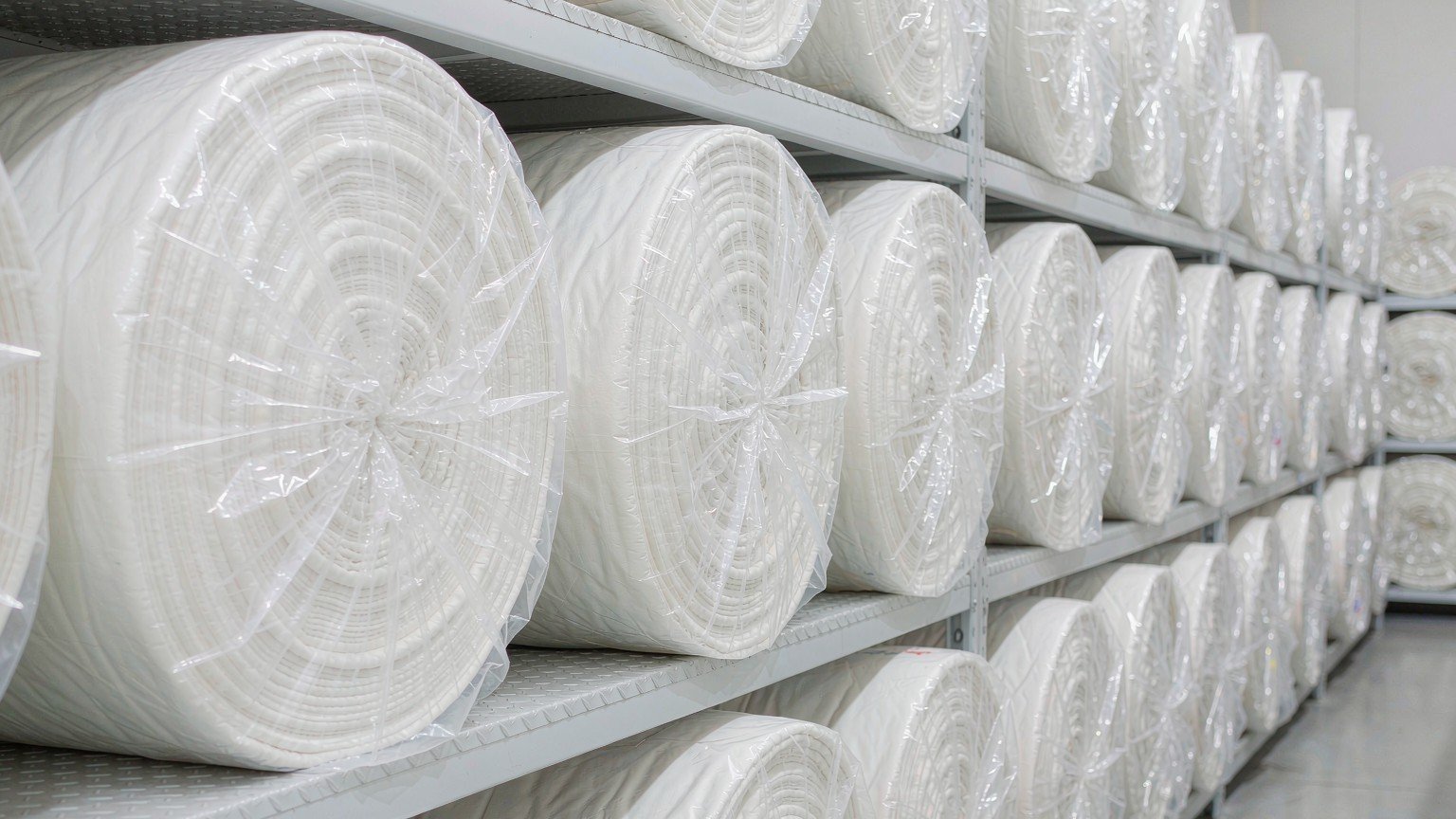
| Packing | Rolled on tubes, moisture barrier | No pressed bales, no compression creases |
That last line is not cosmetic. Pressed export bales strapped at high tension set horizontal creases into the fabric that the buyer cannot steam out and the mill did not create. Rolled packing with an inner liner avoids it for a cost of roughly $0.06 to $0.10 per metre.
Five Mistakes That Produce Crease Complaints
Most crease disputes are decided long before the fabric ships, in the way the specification was written.
- Using “wrinkle free” as a specification. It describes an outcome with three possible routes and no test. Replace it with the crease recovery value, the test method and the wash cycle count.
- Choosing a heavy quality for a hot market. Crease recovery is not the only performance a Gulf buyer needs. At 190 to 220 GSM, a heat-set polyester thobe stays crisp and holds a silhouette, but in July the wearer pays for it in comfort.
- Ordering white with top-temperature resin curing. Yellowing in a white resin-finished thobe usually traces back to curing conditions rather than to the fibre. Specify whiteness after washing, not before.
- Forgetting laundry conditions. A 30 °C domestic wash and a 60 °C industrial wash age a resin finish at completely different rates. Tell the mill where the garment will actually be laundered.
- Accepting a lab dip as a wrinkle test. A lab dip proves shade. It proves nothing about crease behaviour, and it is the single most common substitution we see in an approval file.
Two Orders, Two Outcomes
Both buyers ordered a white thobe quality at the same GSM. One specified the recovery route and the other specified a phrase.
An importer in Dubai ordered 12,000 metres of 118 GSM white in four shades for a retail programme, with the crease recovery specified as ≥ 260° to AATCC 66, heat set at 190 to 200 °C, and a wash-tested whiteness floor of L* 93. The first sample failed the twenty-cycle smoothness grade at SA-3 and was re-finished and re-submitted before the bulk ran. The programme shipped two weeks later than planned and had no crease returns in the following season.
A garment maker in Jeddah ordered a similar white cloth described only as “easy care, wrinkle free, cotton feel”. The mill supplied a resin-finished cotton-rich quality, which passed the fresh swatch comfortably. The garments were laundered at 60 °C in the retailer’s central laundry, and by wash fifteen the recovery had fallen to roughly SA-2. The re-order was placed with a heat-set polyester quality, and the resin quality was written off as sampling cost.
Neither order failed because of the mill. One specification was testable and one was not.
Four Steps From Enquiry to Shipment
A wrinkle-free thobe fabric order is fixed by four decisions, and the recovery route is the one to settle first.
- Select the quality. Composition, GSM, weave, width and crease route, agreed against a garment sample or an unlabelled reference. Our GSM selection guide covers the weight bands and our price tier comparison shows what each band buys in yarn, construction and finish.
- Sample and approve. Lab dip plus full-width yardage, 7 to 10 days per round, with the crease recovery angle and a five-cycle smoothness grade reported together.
- Confirm and reserve. Deposit, PO with the twelve specification lines above, and yarn reservation against a dated production slot.
- Produce, inspect and ship. Heat setting or resin finishing, four-point inspection per our pre-bulk quality checks, rolled packing and container booking, 45 to 75 days from deposit.
Sourcing a daily-wear non-iron polyester quality rather than rebuilding a specification? Our non-iron thobe fabric care and fibre guide covers the six-point care routine and the Micro polyester weight we recommend for Saudi daily thobes. To fix a crease specification for the 2027 season, send the target GSM, the destination market and whether the garment will be domestically or industrially laundered through our thobe fabric enquiry form. We will return a crease recovery value, a wash-durability figure and a price in the same reply, so the decision can be made on data rather than on a description.
Frequently Asked Questions
What is the best fabric for a wrinkle free thobe?
Heat-set 100% polyester and TR (polyester-rayon) blends give the most durable wrinkle free thobe fabric, because the crease recovery comes from the fibre itself and is locked in by heat setting at 180 to 210 degrees Celsius. A heat-set 100% polyester thobe typically measures a crease recovery angle of 260 to 300 degrees, and because there is no surface finish to wear away, that performance is still there after fifty washes. Resin-finished cotton can start higher on a fresh swatch, but it loses 20 to 40 percent of its recovery over repeated laundering. For a thobe that must look crisp after a full day of wear, heat-set polyester or a 65/35 polyester-rayon blend is the practical choice.
Does wrinkle free thobe fabric mean chemical finishing?
Not always, and the distinction matters for certification. Wrinkle free performance in polyester and TR thobe fabric is produced by heat setting, which is a physical process using temperature and tension, and no cross-linking chemistry is involved. Resin finishes that make cotton and cotton-rich blends crease resistant do use chemistry, most commonly DMDHEU or a formaldehyde-free alternative such as a polycarboxylic acid. If your order needs an OEKO-TEX Standard 100 certificate, ask the mill which route the quality takes, because resin-treated cellulose grades carry free formaldehyde limits of 16 ppm for Class I and 75 ppm for Class II under the current OEKO-TEX limit values, tested to ISO 14184-1 or AATCC 112.
How do I test wrinkle resistance before placing a bulk thobe order?
Test at three levels. On the swatch, ask for the crease recovery angle measured to AATCC 66 or ISO 2313, and expect 260 to 300 degrees for heat-set polyester, 240 to 280 for TR 65/35 and 190 to 230 for a resin-finished cotton-rich blend. On a full-width yardage sample, run five wash cycles to ISO 6330 at 40 degrees and grade the smoothness against the ISO 7768 or AATCC 124 replication standards, which run SA-1 to SA-5. On a sewn sample, sit on the garment for two hours and photograph the lap under D65 light. The third test is the one that matches what the customer will actually complain about.
Why does my thobe crease after a long day even though it is wrinkle free?
Three causes dominate. First, heat-set polyester recovers from folding but not from sustained compression with heat and moisture, which is exactly what happens when a wearer sits for several hours, so a light steam is usually enough to release it. Second, many so-called wrinkle free qualities are only resin-treated on a lightweight cotton base, and resin recovery falls away as the finish abrades, so performance drops after twenty to fifty industrial washes. Third, creases can be set into the fabric during shipping if rolls are strapped into pressed bales rather than rolled on tubes, which produces compression creases that no fibre can recover from on its own.
Is wrinkle free thobe fabric good for hot Gulf summers?
It depends on which route you chose. A 110 to 125 GSM heat-set polyester thobe with a soft, matte finish and air permeability above 240 mm/s (ISO 9237) wears comfortably in Riyadh and Jeddah summer heat, and it stays crisp, which is why many Gulf wholesalers standardise on it for the peak season. Heavier heat-set qualities above 150 GSM, or resin-finished cotton-rich grades, hold more heat against the body and are better suited to winter or to air-conditioned office uniforms. Specify GSM and air permeability together, not wrinkle resistance alone, when the destination is the Gulf in July.