White thobe fabric yellows for five reasons, and only one of them happens in the washing machine: optical brightener loss, alkaline detergent residue, chlorine bleach attack on polyester, heat and UV oxidation, and phenol migration from cheap packaging. The other four are decided at the mill, in the specification you approve before the first meter is woven.
That is why the complaint usually arrives three months after delivery, from a retailer in Riyadh or a laundry in Jeddah, and why the mill and the customer then spend a month arguing about who is responsible.
In ten years of exporting white thobe fabric into the Gulf, we have found that whiteness complaints almost never trace back to the fibre. They trace back to a brightener applied on the surface instead of inside the fibre, a base fabric that was never truly white to begin with, or a purchase order that specified GSM and price but said nothing about whiteness retention.
This guide covers the five causes in the order they actually occur, the specifications that prevent them, and the tests that let you settle the question before you commit to a dye lot.
The Short Answer: White Thobe Fabric Yellowing
White thobe fabric yellowing is a whiteness-retention failure, not a cleaning failure, and it is controlled by four numbers written into the purchase order: base fabric L* of 93 or higher, the optical brightener applied in the fibre rather than padded on the surface, CIE whiteness still above 140 after 50 wash cycles, and shrinkage held to ±2 percent.
| Cause | Where it happens | What it looks like | Prevention |
|---|---|---|---|
| Brightener loss | Mill finish + wash cycles | Even overall dulling, no pattern | Fiber-integrated brightener, L* ≥ 93 base |
| Detergent residue | Laundry | Uniform pale yellow, cloth feels stiff or waxy | Halve detergent dose, add a strip wash cycle |
| Chlorine bleach | Laundry | Permanent yellow cast, weak collars and cuffs | Oxygen-based whitener only on blends |
| Heat and UV oxidation | Drying and ironing | Yellowing along folds and exposed panels | Shade drying, iron below 150 °C |
| Phenol migration | Storage and packaging | Yellowing that starts at the outer fold | Phenol-free film, dry dark storage |
Everything below explains how each row is controlled in practice.
Why White Thobe Fabric Turns Yellow: The Five Causes
The five causes are not equally common, and the ranking matters because it determines where you spend your quality budget. In our claim history, brightener loss and detergent residue together account for roughly seven out of ten cases.
- Optical brightener loss. Optical brighteners are fluorescent dyes that absorb ultraviolet light and re-emit it as visible blue-white. They do not survive indefinitely. A brightener padded onto the surface washes out within fifteen to twenty cycles; one applied during dyeing, inside the fibre, holds far longer.
- Detergent residue. Overdosing detergent is the single most common consumer error. Residue that is not rinsed out oxidises with body oils and heat, and the fabric takes on an even, slightly waxy yellow tone rather than a patchy stain.
- Chlorine bleach attack. Chlorine reacts with polyester and leaves damage that cannot be reversed. This is the only cause on the list that is permanent from the first incident.
- Heat and UV oxidation. White cloth dried in full Gulf sun for hours, or pressed above 150 °C, degrades at the fibre surface. Yellowing appears first along fold lines and on the panels most exposed to light.
- Phenol migration. Certain antioxidants used in low-grade polyethylene packaging, and BHT in particular, migrate into fabric during long storage and oxidise into a yellow compound. The tell-tale sign is yellowing that begins at the outer fold and moves inward.
The Cause Most Buyers Miss: Whiteness Is Set at the Mill
Base fabric whiteness is a mill decision, and it is invisible on a delivery note, which is why it becomes a dispute rather than a rejection.
A white thobe fabric has two whiteness components. The first is the natural whiteness of the yarn and the fabric after scouring and heat-setting, measured as an L value on the CIE Lab scale. The second is what the brightener adds on top. A fabric with an L of 90 that is heavily brightened can look brilliant under showroom lighting and go grey after a year, because the brightener is doing work the base fabric should have done.
Two questions separate a durable white from a cheap one:
- Is the brightener fiber-integrated or surface-applied? Fiber-integrated means it goes into the dyebath or is added at the polymer stage, so it sits inside the fibre and survives washing. Surface padding is faster and cheaper and washes out first.
- What is the base fabric L before brightening? Ask for the number, not the appearance. An L of 93 or above means the cloth is genuinely white without help.
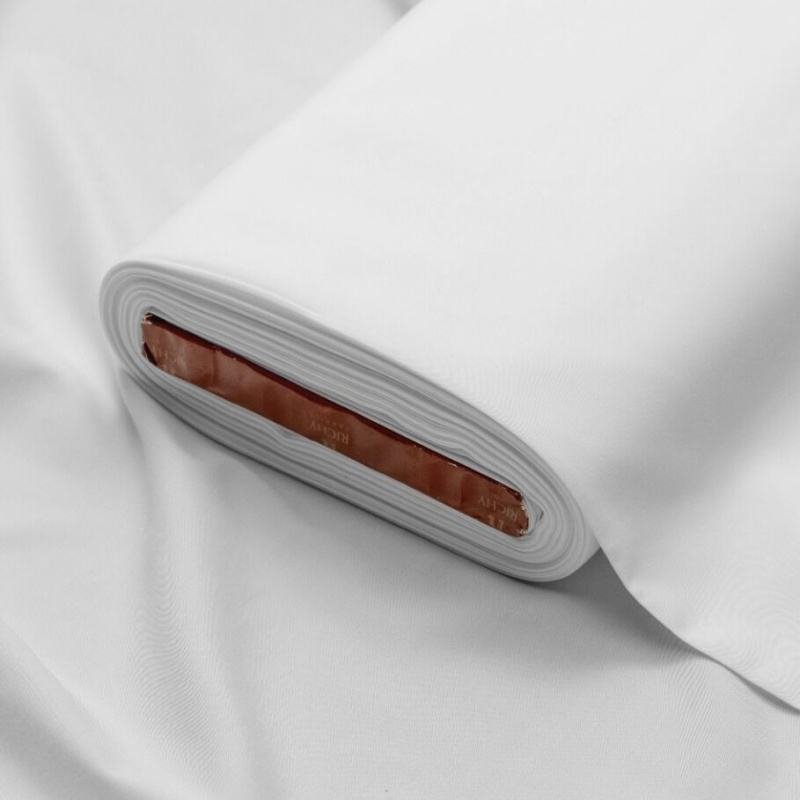
For a white thobe quality, we run 120–160 GSM in a fine plain weave or micro-dobby structure, with a soft finish and a matte surface. The matte surface matters more than buyers expect: high-gloss calendered white reflects light unevenly and shows any yellowing far earlier than a matte cloth of identical whiteness.
Which Thobe Fabric Resists Yellowing Best?
At equal care, yellowing resistance runs in the order polyester, TR, TC, cotton, because moisture and fibre chemistry determine how much residue and bleach the cloth retains.
| Quality | Whiteness retention | Why | Typical GSM | FOB price per meter |
|---|---|---|---|---|
| 100% polyester (Micro, BS) | Excellent | Almost no moisture uptake, brightener sits in the fibre, no cellulose to oxidise | 110–150 | $0.76–$1.20 |
| TR 65/35 poly-rayon | Very good | Viscose is more stable with brighteners than cotton and absorbs less residue | 130–180 | $1.30–$1.90 |
| TC 65/35 poly-cotton | Good | Polyester helps, but cotton absorbs sweat, oils and detergent residue | 120–155 | $0.95–$1.45 |
| TC with chlorine-resistant finish | Very good | Engineered for industrial laundry; survives periodic bleach exposure | 135–165 | $1.20–$1.70 |
| 100% cotton, mercerised | Fair | Mercerising improves brightener uptake, but cellulose yellows under heat and UV | 120–160 | $1.45–$2.30 |
The table is a starting point, not a verdict. A 100 percent polyester thobe at $1.05 that keeps its whiteness through two years of wear is cheaper per wearing than a $0.70 cotton blend that looks tired at six months. If your customer base includes commercial laundries, the chlorine-resistant TC finish is usually the better commercial answer regardless of fibre preference.
Our thobe fabric GSM weight guide covers how weight interacts with weave density and opacity in white.
Five Specs to Write Into a White Thobe Fabric Order
A white thobe purchase order needs five lines that most importers leave out, and all five are measurable before shipment.
- Base fabric L* ≥ 93, stated before optical brightening.
- Brightener application method, written as fiber-integrated, with a wash-survival figure attached.
- Dimensional change after five washes at 40 °C, ±2 percent maximum in both warp and weft.
- Colour fastness grade 4 minimum to washing (ISO 105-C06) and grade 4 dry / grade 3 wet to rubbing (ISO 105-X12).
- Whiteness after 50 cycles, CIE above 140, with a wash-test report rather than a single-wash certificate.
Add a retained-sample requirement: one sealed swatch per production lot, held by the mill for twelve months. When a claim arrives, it is settled against the physical sample instead of a photograph taken under unknown lighting.
How to Test Whiteness Retention Before You Commit
Ask for a staged wash report at 0, 10, 20, 30 and 50 cycles, because a single-wash certificate tells you almost nothing about month six.
The protocol is straightforward and any serious mill can run it:
- Measure CIE whiteness index and L* on the untreated swatch and record it as the baseline.
- Wash a set of swatches at 60 °C with a standard reference detergent, without optical brighteners, and pull one swatch at each interval.
- Photograph all five swatches together in one frame under the same light, so the drift is visible rather than described.
- Report dimensional change and colour change on the grey scale at each interval.
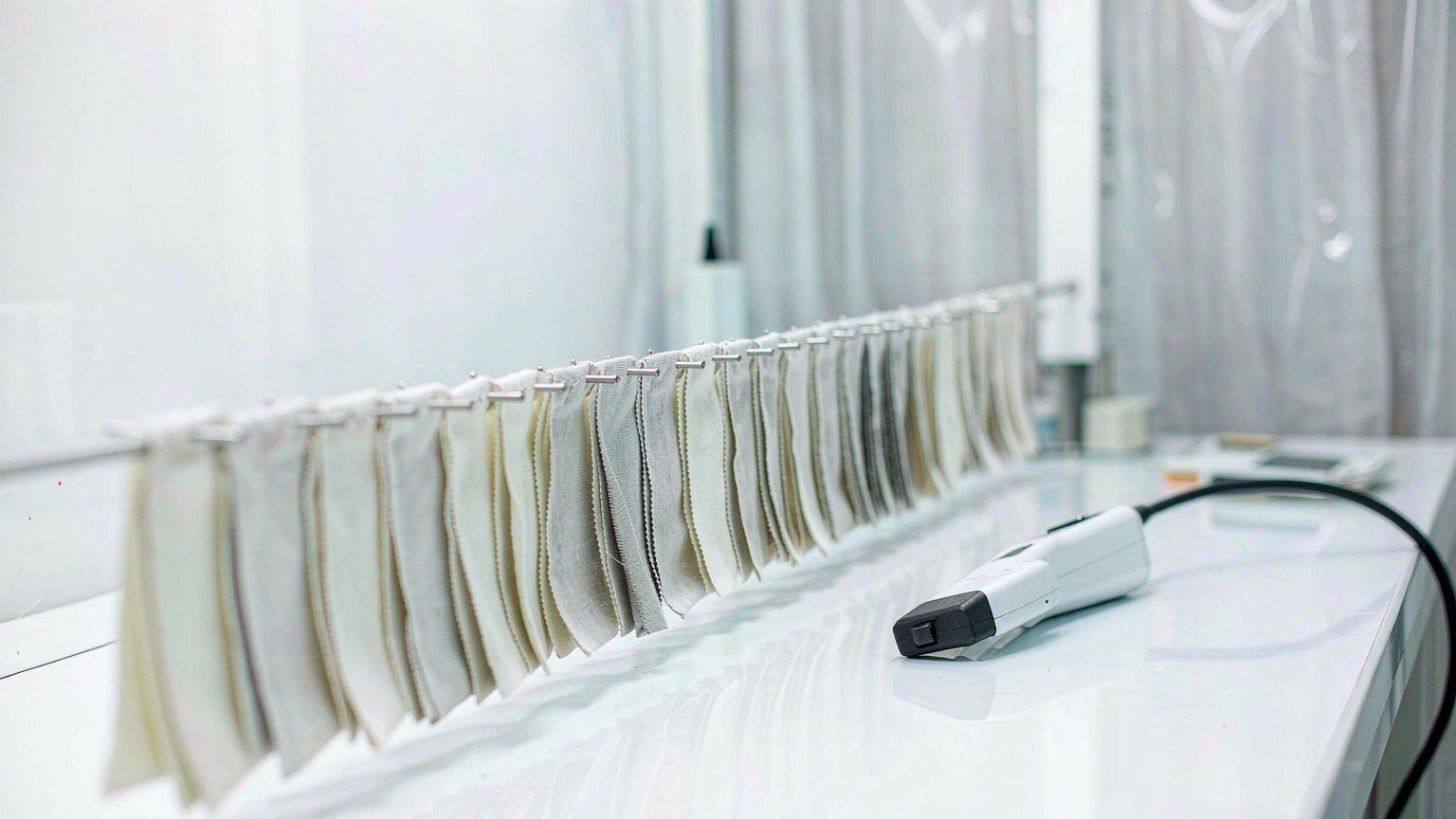
A garment factory in Jeddah that produces white thobes for corporate clients changed its incoming inspection to include a 20-cycle wash on every new white lot. Within one season it had rejected two lots that passed the visual check on delivery but dropped three grades in whiteness by cycle 20. Both rejections happened before cutting, which is the only point at which a whiteness problem is cheap to solve.
Care and Storage Rules for Retailers and Laundries
Whiteness is lost in four places after delivery: the wash cycle, the drying method, the iron, and the storage room, and each has a simple countermeasure.
- Wash at 60 °C maximum on white only, never mixed with coloured garments, and reduce the detergent dose by half. If residue is already present, one hot strip wash without detergent removes most of it.
- Never use chlorine bleach on a poly-cotton or polyester thobe. Use an oxygen-based whitener such as sodium percarbonate, dissolved in warm water before the garment goes in.
- Dry in shade. Direct Gulf sun degrades brighteners and fibre surfaces faster than any other single factor.
- Iron below 150 °C, and never press a still-damp white thobe at high temperature, which sets both yellowing and shine.
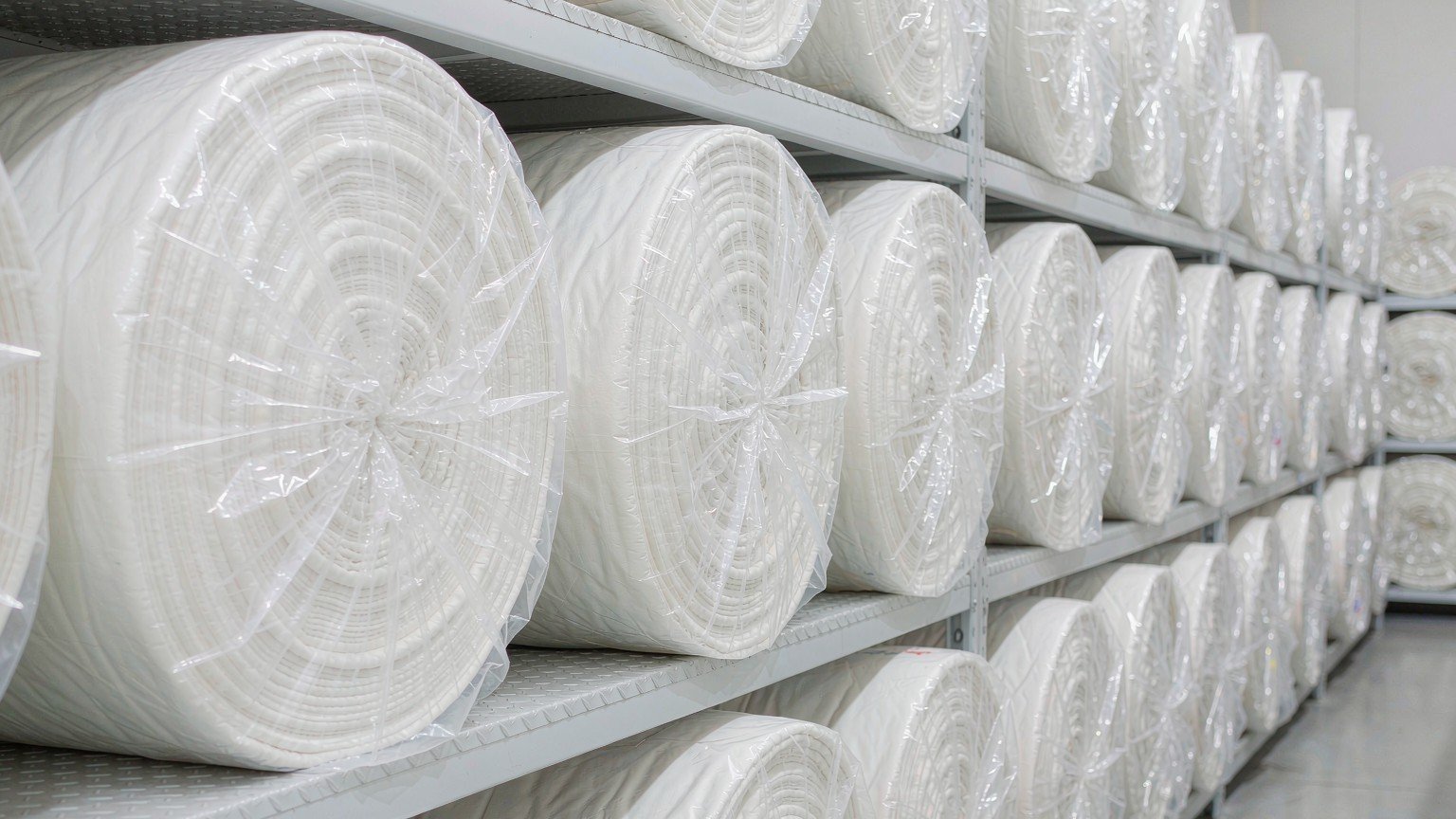
- Store dry and dark, on shelves rather than against concrete, in phenol-free film, away from dyed goods and newsprint, with first-in first-out rotation.
- Re-inspect anything held over six months before it leaves the warehouse.
Handling a Yellowing Claim Without Losing the Customer
Most yellowing disputes are resolvable in a week if the mill, the brand and the laundry agree on one thing: the cause can be identified from the pattern, not from the intensity.
Even yellowing across the whole garment points to brightener loss or detergent residue. Yellowing concentrated at the collar and underarms points to sweat and antiperspirant chemistry. Yellowing along folds and exposed panels points to heat or light. Yellowing that starts at the outer fold of an unfolded roll points to packaging. A mill can reasonably be held responsible for the first pattern if the specified L* and brightener method were not met. It cannot be held responsible for chlorine bleach or direct-sun drying, and a written care specification delivered with every roll prevents that argument from becoming a credit note.
What a mill can genuinely guarantee is predictable, measurable whiteness retention backed by wash-test data. What no mill can honestly guarantee is that white fabric will never yellow, regardless of how it is washed and stored. Buyers who ask for that guarantee are buying a promise rather than a product.
How to Order White Thobe Fabric
White thobe fabric orders run in four steps, and the whiteness specification is fixed before the sample is approved so nothing changes between the swatch and the bulk run.
- Send the specification. Composition, GSM band, weave, target L* and whiteness-retention requirement, plus your market and typical washing conditions.
- Sample and test. A free swatch for hand feel, plus a 20-cycle wash report on the quality you are considering, typically within 7–10 days.
- Confirm the volume. White runs from about 1,000 meters because no dye lot setup is required; tinted whites and shades start at 1,500–3,000 meters per colour. Production runs 25–35 days, then 20–28 days by sea to Jeddah, Dammam or Jebel Ali.
- Inspect and receive. Pre-shipment inspection covering GSM, shade, whiteness index and dimensional stability, with a retained sample per lot.
If your volumes span retail white and dyed qualities, the wholesale ordering guide explains how to consolidate them into one production slot and where the volume tiers fall. For brand-specific labelling and packaging, the custom OEM programme covers what can be specified.
Send your composition, GSM band and whiteness requirement through the RFQ form, or message us on WhatsApp with a photo of the white quality you currently buy. We will come back with a price band, a wash-test report on the closest match in our range, and a free swatch so your team can compare whiteness in daylight before committing volume.
Frequently Asked Questions
Why does white thobe fabric turn yellow?
White thobe fabric turns yellow for five main reasons: loss of the optical brightener that makes the cloth read white, alkaline detergent residue left in the fibre after incomplete rinsing, chlorine bleach attacking polyester in poly-cotton blends, heat and UV oxidation of the fibre surface, and phenol-based antioxidants migrating out of cheap polyethylene packaging during storage. Only the first two happen in a domestic laundry. The other three are decided by what you specified at the mill and how the fabric was packed and stored. That is why two white thobe qualities bought at the same price can look identical on delivery and completely different after three months of wear.
Which thobe fabric stays white the longest?
At equal care, 100 percent polyester holds whiteness the longest, followed by TR 65/35, then TC 65/35, with mercerised cotton last. The reason is moisture and chemistry rather than marketing: polyester absorbs almost no water, so detergent residue, sweat salts and bleach have far less to react with inside the fibre, and its optical brightener survives more wash cycles. Viscose in a TR blend is more stable with brighteners than cotton. If your market washes hard, or a uniform programme runs through industrial laundry, specify TC 65/35 with a chlorine-resistant finish instead, which trades a little initial softness for far better whiteness retention over 50 cycles.
How do I test whether white thobe fabric will yellow before I order 3000 meters?
Ask the mill for a wash-test report at 0, 10, 20, 30 and 50 cycles rather than a single-wash certificate. The numbers to request are CIE whiteness index and the L value of the base fabric, dimensional change, and colour change on the grey scale. Base fabric L should be 93 or above before any brightener is applied, and a white programme should still hold CIE whiteness above 140 after 50 industrial cycles. Ask for photographs of the same swatch at each interval, and keep a retained sample of the shipping lot so any later dispute can be settled against a physical reference instead of an opinion.
Does chlorine bleach cause yellow thobes?
Yes, and it is the most expensive mistake a laundry can make. Chlorine bleach attacks polyester, which is the majority fibre in most modern thobe fabric, and the damage shows up as a permanent dull yellow cast that no amount of rewashing removes, together with weakened fibres that fail at the collar and cuff. White cotton can tolerate controlled chlorine, but a 65/35 poly-cotton thobe cannot. Specify an oxygen-based whitener such as sodium percarbonate for white thobe fabric instead, and if you run a commercial laundry, ask the mill for a chlorine-resistance rating on the finish, because some whites are engineered for periodic bleach exposure and most are not.
How should retailers store white thobe fabric to stop it going yellow?
Store white thobe fabric in a dry, dark, well-ventilated room at 15–25 °C and below 60 percent relative humidity, on shelving rather than against a concrete wall, because concrete transmits moisture. Keep the rolls wrapped in polythene that is free of phenol-based antioxidants, since cheap recycled film can migrate BHT into the fabric and yellow it from the outside in. Never store white cloth in the same bay as dyed or greige goods, do not press it against cardboard or newsprint, and rotate stock on a first-in first-out basis. Fabric held more than six months without rotation should be re-inspected before it ships to a customer.
Frequently Asked Questions
Why does white thobe fabric turn yellow?
White thobe fabric turns yellow for five main reasons: loss of the optical brightener that makes the cloth read white, alkaline detergent residue left in the fibre after incomplete rinsing, chlorine bleach attacking polyester in poly-cotton blends, heat and UV oxidation of the fibre surface, and phenol-based antioxidants migrating out of cheap polyethylene packaging during storage. Only the first two happen in a domestic laundry. The other three are decided by what you specified at the mill and how the fabric was packed and stored. That is why two white thobe qualities bought at the same price can look identical on delivery and completely different after three months of wear.
Which thobe fabric stays white the longest?
At equal care, 100 percent polyester holds whiteness the longest, followed by TR 65/35, then TC 65/35, with mercerised cotton last. The reason is moisture and chemistry rather than marketing: polyester absorbs almost no water, so detergent residue, sweat salts and bleach have far less to react with inside the fibre, and its optical brightener survives more wash cycles. Viscose in a TR blend is more stable with brighteners than cotton. If your market washes hard, or a uniform programme runs through industrial laundry, specify TC 65/35 with a chlorine-resistant finish instead, which trades a little initial softness for far better whiteness retention over 50 cycles.
How do I test whether white thobe fabric will yellow before I order 3000 meters?
Ask the mill for a wash-test report at 0, 10, 20, 30 and 50 cycles rather than a single-wash certificate. The numbers to request are CIE whiteness index and the L star value of the base fabric, dimensional change, and colour change on the grey scale. Base fabric L star should be 93 or above before any brightener is applied, and a white programme should still hold CIE whiteness above 140 after 50 industrial cycles. Ask for photographs of the same swatch at each interval, and keep a retained sample of the shipping lot so any later dispute can be settled against a physical reference instead of an opinion.
Does chlorine bleach cause yellow thobes?
Yes, and it is the most expensive mistake a laundry can make. Chlorine bleach attacks polyester, which is the majority fibre in most modern thobe fabric, and the damage shows up as a permanent dull yellow cast that no amount of rewashing removes, together with weakened fibres that fail at the collar and cuff. White cotton can tolerate controlled chlorine, but a 65/35 poly-cotton thobe cannot. Specify an oxygen-based whitener such as sodium percarbonate for white thobe fabric instead, and if you run a commercial laundry, ask the mill for a chlorine-resistance rating on the finish, because some whites are engineered for periodic bleach exposure and most are not.
How should retailers store white thobe fabric to stop it going yellow?
Store white thobe fabric in a dry, dark, well-ventilated room at 15-25 degrees Celsius and below 60 percent relative humidity, on shelving rather than against a concrete wall, because concrete transmits moisture. Keep the rolls wrapped in polythene that is free of phenol-based antioxidants, since cheap recycled film can migrate BHT into the fabric and yellow it from the outside in. Never store white cloth in the same bay as dyed or greige goods, do not press it against cardboard or newsprint, and rotate stock on a first-in first-out basis. Fabric held more than six months without rotation should be re-inspected before it ships to a customer.