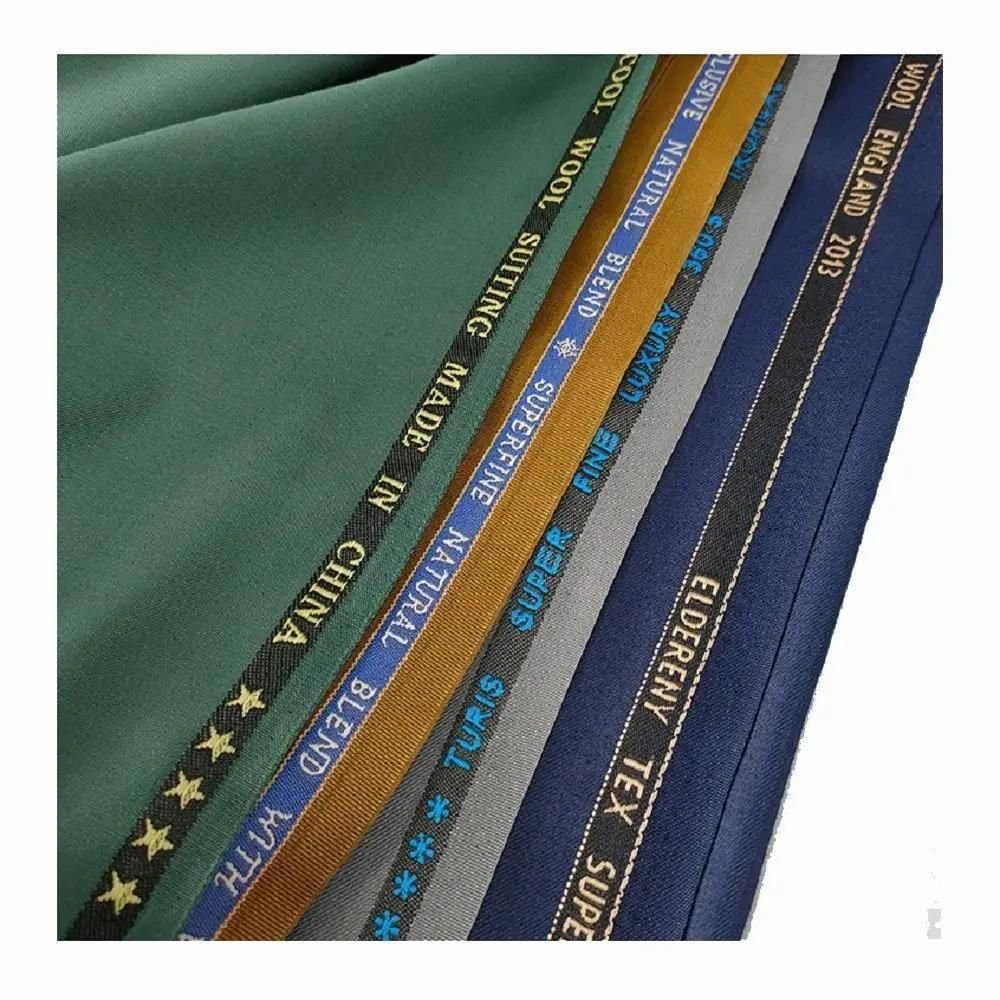
The Short Answer: Thobe Fabric Shrinkage Is a Mill Setting, Not a Fabric Trait
Our polyester thobe fabric is guaranteed to move no more than 1.2 percent in the warp and 1.0 percent in the weft after three washes at 40 °C to ISO 6330, polyester-viscose 65/35 holds 2.0 percent, and un-pre-shrunk cotton-rich cloth can move 4 to 6 percent — roughly six to nine centimetres off a 145 cm robe.
Shrinkage is the one specification that never appears on a swatch card and always appears on a claim form. It is set by how the mill weaves, washes and heats the cloth, not by the fibre name alone.
In ten years of shipping thobe and kandura cloth into the Gulf, the arguments we settle are almost never about colour. They are about a robe that measured 145 cm on the sample and 141 cm on the bulk.
Send us your construction and we will return the shrinkage figures with the price — GSM, width and colour count are enough to start. If you already have a bulk lot in dispute, message us on WhatsApp from the same page and we will tell you what the numbers should have been.
Why Shrinkage Is a Cutting-Room Problem Before It Is a Fabric Problem
A thobe that comes back short was usually cut from cloth that had not finished relaxing, and the cutting room paid for it in lost length rather than the mill paying for it in credit.
Woven cloth carries tension from the loom. Warp yarns are held under let-off tension for the whole beam, and the finished fabric is pulled to width on a stenter so the weft sits straighter and the surface reads cleaner under light.
That tension is stored, not removed. The first domestic wash releases it, the warp crimp recovers, and the cloth draws in.
The arithmetic is unforgiving on a robe. A thobe body panel runs 140 to 150 cm, so one percent of warp shrinkage is 1.4 to 1.5 cm of length. Four percent is a size break, and it arrives after the garment has been sold, worn and washed.
The Tolerances We Hold by Construction
Polyester moves least, cotton-rich cloth moves most, and the number a buyer should care about is the figure after three washes rather than the figure quoted on the invoice.
| Construction | GSM | Warp, 3 washes | Weft, 3 washes | After 50 washes | Typical buyer |
|---|---|---|---|---|---|
| 100% spun polyester, plain | 110-125 | -0.8 to -1.2% | -0.6 to -1.0% | +0.4% | Saudi daily wear, volume programmes |
| 100% polyester, fine count, Schreiner | 110-125 | -1.0 to -1.2% | -0.8 to -1.0% | +0.5% | Emirati kandura, retail chains |
| Polyester-viscose 65/35, relaxed | 110-130 | -1.5 to -1.8% | -1.2 to -1.5% | +0.8% | Premium drape, Kuwait and Qatar |
| Polyester-viscose 50/50, relaxed | 120-140 | -2.0 to -2.5% | -1.6 to -2.0% | +1.0% | Soft-hand summer ranges |
| Poly-cotton TC 65/35, sanforized | 120-140 | -2.0 to -2.5% | -1.8 to -2.0% | +0.8% | Uniform and corporate programmes |
| 100% cotton, sanforized | 120-160 | -1.0 to -1.5% | -1.0 to -1.2% | +1.0% | Niche premium, Morocco and Egypt |
| 100% cotton, not pre-shrunk | 120-160 | -4.0 to -6.0% | -3.0 to -4.0% | +1.5% | Avoid for cut-and-ship robes |
| Yarn-dyed dobby, polyester | 140-200 | -1.2 to -1.5% | -1.0 to -1.2% | +0.6% | Eid and occasion ranges |
The cloth that moves most is also the cloth that feels best on the sample table, which is how buyers end up specifying it for a programme that cannot absorb the movement.
What Actually Causes the Movement
Four things decide the number: loom tension, the relaxation given after dyeing, the stenter width, and any heat-setting or resin finish applied at the end.
- Loom tension. A tight warp beam produces cleaner cloth and more stored stretch. Coarser yarn counts at high density hold more of it.
- Relaxation after dyeing. Jet or overflow dyeing relaxes cloth far better than a pad-batch route. A mill that skips an open-width wash after dyeing is selling you tension in a roll.
- Stenter width. Cloth pulled 2 to 4 cm wider than its natural width looks better under the inspection light and returns to natural width in the first wash.
- Heat-setting and calendering. A thermofix pass on polyester locks the structure and cuts movement by one to two points. Calendering, which we cover in the calendering guide, improves surface and gloss but does not fix dimensional stability on its own.
How the Test Is Run, and Why the Method Matters More Than the Number
A shrinkage figure without a test method is a slogan, because wash temperature and drying method can swing the result by a full percentage point.
| Standard | What it fixes | What we report |
|---|---|---|
| ISO 3759 | Marking and measuring of specimens | 500 mm gauge marked on each specimen |
| ISO 6330 | Domestic washing procedure | 40 °C, 3 cycles, line dry |
| ISO 5077 | Calculation of dimensional change | Warp and weft reported separately |
| AATCC 135 | US domestic wash alternative | Offered when a US buyer specifies it |
| Buyer protocol | 5 or 10 wash cycles | Available on request at quote stage |
A report that states a single percentage is not usable, because a robe fails on length long before it fails on width.
Third-party testing at SGS, Intertek or BV costs USD 60 to 120 per test and takes three to five working days.
Pre-Shrunk, Sanforized, Heat-Set: What the Words Actually Buy
Each label describes a different mechanical step, and only two of them change the number in a way a thobe buyer will notice.
| Claim on the offer sheet | Step actually performed | Effect on shrink | Cost adder |
|---|---|---|---|
| Heat-set / thermofix | Polyester stabilised under tension at 170-190 °C | -1 to -2 points, warp mainly | +USD 0.02-0.05/m |
| Sanforized | Compressive shrinking between felt and drum | -1 to -2 points on cotton blends | +USD 0.04-0.09/m |
| Relaxed / open-width washed | Free relaxation after dyeing, no tension | -1 to -3 points, both directions | +USD 0.05-0.12/m |
| Easy-care resin | Crosslinking finish | Dimension holds, hand stiffens | +USD 0.06-0.12/m |
| “Pre-shrunk” with no data | Nothing verifiable | Unknown | Priced as if free |
Resin is also where a white robe fails Saudi conformity testing, because the free formaldehyde limit for skin-contact articles is 75 ppm. If easy-care is offered cheaply, ask which resin and for the formaldehyde result.
The Cost of Buying the Problem Out
Pre-shrinking adds two to twelve cents a metre and removes a claim that runs into thousands of dollars, so the comparison is not close.
Take a 12,000-robe programme at 3.8 m per robe, about 45,600 m. A relaxation wash at USD 0.06 per metre adds USD 2,736.
Now take the failure. A 4 percent warp loss on a 145 cm robe is 5.8 cm, which turns a size 60 into a size 58 in the customer’s hands. A 3 percent claim rate on 12,000 robes at a USD 12 landed cost per garment is USD 4,320, before freight on returns, before the retailer’s chargeback and before the buyer stops reordering.
The cheaper line on the quotation is the expensive one in the claim file, which is the same logic behind our 50-wash durability data.
Five Checks Before You Commit to a Bulk Lot
You can verify a shrinkage claim in an afternoon with a metre rule, a domestic washing machine and one cut specimen, and no supplier should refuse the request.
- Ask for a lot-level report, not a certificate. A certificate covers a product family. A report covers the cloth in your container.
- Cut one metre from the bulk and wash it. Three cycles at 40 °C, line dry, measured on a 500 mm gauge before and after. If the mill’s figure and yours differ by more than 0.5 points, ask why.
- Ask whether the roll rested 24 hours before cutting. Cloth cut straight off the loom and wrapped the same day has not finished relaxing.
- Compare delivered width with greige width. Two centimetres of extra width that disappears in the wash was never yours.
Our pre-bulk quality check list covers the other five measurements that travel with shrinkage on a thobe order: GSM, width, colour fastness, whiteness and seam strength.
Request a swatch and the shrinkage report for your construction — we send both together, because a swatch without a number tells you how the cloth feels, not how it will behave.
The Clause That Settles the Argument Later
A purchase order that states a percentage without a standard, a sampling frequency and a remedy is an invitation to negotiate after the container arrives.
| Item | Wording that works | Remedy if breached |
|---|---|---|
| Method | ISO 6330, 40 °C, 3 cycles, line dry, measured to ISO 3759/5077 | Report required before shipment |
| Limit | ≤1.5% warp, ≤1.2% weft | Credit or replacement of affected metres |
| Sampling | One test per dye lot, minimum one per 5,000 m | Missing report holds the balance payment |
| Width | 150 cm usable, ±2 cm, measured after relaxation | Reject or price adjustment |
| Cut allowance | Buyer adds 2% marker length when ordering unsanforized cloth | Buyer’s responsibility once declared |
Put the cut allowance in writing even when you are not using it: it stops the argument about who should have allowed for movement.
Order quantities and timing sit behind all of this: stock white from 500 m per colour ships in 7 to 15 days, custom shades from 2,500 m take 18 to 25 days, and a pre-shrinking or relaxation step adds 3 to 5 days to either. Our MOQ breakdown explains why the jump from stock to custom dye is a scheduling question rather than a price one, and the per-metre price page shows what the finish adders do to the final figure.
Ask for a quote with shrinkage written into it — tell us the robe length your pattern uses and we will tell you what allowance to build in before you cut.
Frequently Asked Questions
How much does thobe fabric shrink after washing?
On the qualities we supply, 100 percent spun polyester thobe fabric moves 0.8 to 1.2 percent in the warp and 0.6 to 1.0 percent in the weft after three domestic washes at 40 degrees to ISO 6330. Polyester-viscose 65/35 holds 1.5 to 2.0 percent, and a cotton-rich cloth that has not been pre-shrunk can move 4 to 6 percent in the warp. On a 145 cm robe that last figure is 6 to 9 cm of lost length, which is why cotton programmes are always quoted with a pre-shrinking step and a wash test report attached to the lot.
Should I buy pre-shrunk thobe fabric?
Buy pre-shrunk cloth if you cut to a finished length and ship without a garment wash, because the cutting room then works to the real dimensions instead of guessing an allowance. On polyester qualities the gain is small, one or two percentage points, and the adder is around USD 0.02 to 0.05 per metre. On polyester-viscose and cotton-rich qualities the gain is large, and skipping it moves the risk onto your pattern and your customer claims. The exception is a buyer who garment-washes every robe after sewing: in that case the garment wash itself stabilises the cloth and the fabric-side step can be reduced.
How is fabric shrinkage tested?
Three standards do the work. ISO 3759 sets how the specimen is marked and measured, usually with a 500 mm gauge marked on the cloth. ISO 6330 sets the domestic washing procedure, covering temperature, detergent, ballast and drying method. ISO 5077 sets how the dimensional change is calculated and reported. A US buyer will often ask for AATCC 135 instead. A single test costs USD 60 to 120 at SGS, Intertek or BV and takes three to five working days, and the report is only meaningful when it states the wash temperature, the drying method and the number of cycles.
Why does my thobe fabric measure wider than ordered and then shrink to size?
That is weft tension being released. Fabric is stretched to width on a stenter during finishing, so a 150 cm order can arrive at 152 or 154 cm. The first wash relaxes the weft back towards its natural width, and the cloth also draws in length as the warp crimp recovers. A mill that reports width after relaxation, and states a plus or minus 2 cm tolerance on the order, is telling you the truth about the cloth you will actually cut. Width measured hot off the stenter is a number that disappears in the first laundry cycle.
What tolerance should I write into the purchase order?
Write the test method, not just the number. A workable clause reads: dimensional change after three washes to ISO 6330 at 40 degrees, line dried, not exceeding 1.5 percent warp and 1.2 percent weft, tested once per dye lot, with the report supplied before shipment. Add the remedy you will actually enforce, such as a credit against the affected metres or replacement of the lot. Without a named standard and a named remedy, a 3 percent claim becomes a conversation rather than a settlement, and the buyer usually carries the loss.