Recycled polyester thobe fabric is thobe cloth woven from recovered polyester — usually post-consumer bottle flake — and its practical limits for a Gulf programme are whiteness, shade consistency and documentation, not performance: cost runs about 6 to 14 percent above virgin, minimums start near 2,000 meters, and the recycled content is proven by a GRS transaction certificate rather than by any laboratory test. We have woven thobe, kandura and djellaba cloth for Gulf buyers for ten years, and recycled polyester has moved from an occasional question to a standing item on brand questionnaires in the last eighteen months. This guide covers what changes in the cloth, what does not, and the specification lines to lock before you place a recycled order.
If you are new to the fibre side of thobe cloth, our sustainable thobe fabric guide compares the three routes we quote — recycled polyester, organic cotton blends and certified low-impact viscose. For the appearance standard that any recycled white quality has to match, the white thobe fabric yellowing guide explains how whiteness is measured and what makes white cloth turn.
The Short Answer: Recycled Polyester Thobe Fabric Explained
Recycled polyester thobe fabric is woven and finished exactly like virgin polyester thobe cloth, and the only three things a buyer has to manage are a lower starting whiteness that requires a longer brightening recipe, a wider shade tolerance between lots, and a chain of custody that has to be documented order by order.
| Specification line | Virgin polyester thobe cloth | Recycled polyester thobe cloth | What it means at the cutting table |
|---|---|---|---|
| Feedstock | Petrochemical PET | Post-consumer bottle flake, occasionally textile waste | No visible difference once woven |
| Spinning | Filament or staple as ordered | Usually staple for TR and TC blends, filament on request | Staple is narrower in the counts we can hold in recycled |
| CIE whiteness (brightened white) | Above 140 at 120-140 GSM | 8-14 points lower unless the recipe is extended | A buyer comparing swatches side by side will see it |
| Shade tolerance between lots | ΔE 0.8 or better | ΔE 1.0 to 1.2 unless the mill fixes flake sourcing | Keep recycled qualities on one flake source |
| Specks and contamination | Rare | Occasional grey or dark specks if sorting is loose | Four-point inspection must include a speck count |
| Shrinkage after three washes | 3 to 4 percent maximum | 3 to 4 percent maximum | No practical difference |
| Price premium | Base | Plus 6 to 14 percent | Falls as volume rises |
| Minimum order quantity | 500-1,000 m per colour | 2,000-3,000 m per quality | Rules out small trial programmes |
| Lead time | Stock shades 15-30 days | Add 7 to 14 days for yarn reservation and certificates | Matters for Ramadan and Eid windows |
| Documentation | Composition and test reports | GRS scope certificate plus a transaction certificate per shipment | Requires a paper trail from the buyer side too |
Read that table as a risk list rather than a quality ranking. Recycled polyester is a mature fibre and it performs in a thobe. What it does not do is forgive a loose specification, because the tolerances are wider to begin with.
What Recycled Polyester Thobe Fabric Is Made From
Recycled polyester, usually written rPET, starts as collected PET bottles that are sorted by colour and polymer, washed into flake, decontaminated under heat and then melt-spun into yarn; the yarn is then woven, dyed and finished on the same equipment as virgin polyester.
The route in detail:
- Collection and sorting. Bottles are separated by colour and by polymer type. Clear flake is what white thobe cloth needs, and the price of clear flake tracks demand from the beverage and fibre sectors at the same time.
- Washing and decontamination. Labels, adhesives, caps and residual contents are removed. Any PVC or multilayer bottle that survives sorting becomes a defect in the finished cloth.
- Melt spinning. Flake is dried, extruded and spun. This is where intrinsic viscosity variation shows up, and where a mill decides between recycled staple for spun yarn and recycled filament.
- Yarn preparation. Recycled staple is the practical choice for TR and TC constructions, which is the majority of mid-tier thobe cloth. Recycled filament exists but fewer spinners hold it in thobe counts.
- Weaving, dyeing, finishing. Identical to virgin polyester. Soft finish, delustering, sanforising and optical brightening are separate lines and can be specified on recycled cloth exactly as on virgin.
The honest limitation is upstream, not downstream. A mill can control its brightening recipe and its weave, and it cannot control what was in the bale of bottles. That is why recycled qualities should stay on one flake source for the length of a programme.
The Whiteness Gap: Where rPET Thobe Cloth Is Weakest
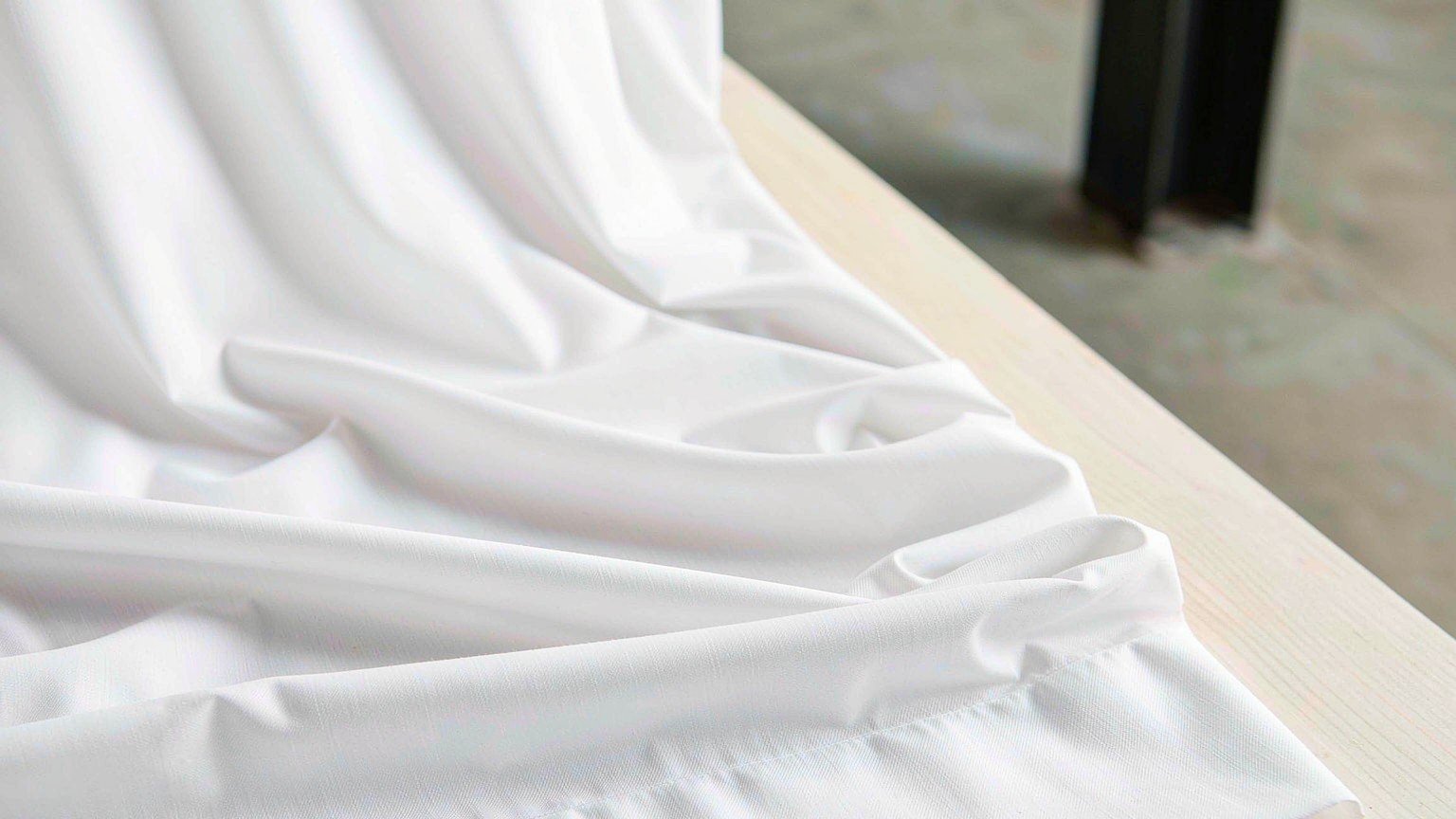
Whiteness is the specification line where recycled polyester gives up the most ground: on our line, brightened virgin polyester thobe cloth at 120 to 140 GSM reads above 140 on the CIE whiteness index, and the same construction in recycled polyester lands 8 to 14 points lower until the brightening step is extended.
Three mechanisms drive that gap.
| Source of the cast | Mechanism | What the mill can do about it |
|---|---|---|
| Residual colourant in clear flake | Traces of blue and green bottle flake survive sorting | Buy separated clear flake, not mixed bale |
| Label adhesive and cap residue | Organic residue yellows under heat in the extruder | Tighter washing and a decontamination step |
| Multilayer and PVC contamination | Foreign polymer creates specks and a grey cast | Optical sorting plus a speck count in inspection |
| Intrinsic viscosity variation | Wider IV spread changes how the yarn takes the brightener | Fixed flake source and blending control |
Extending the brightening recipe recovers most of the difference, and it is not free: a longer brightening line adds cost and a mild loss of hand softness, which matters on a cloth that is judged by drape. Two practical consequences follow. First, ask for the whiteness value on finished cloth, not on greige, because brightening is applied after weaving. Second, if a programme sells white thobes against a retail shelf where two qualities will sit side by side, compare the recycled and virgin samples in the same light before committing.
We have written in more detail about how whiteness is measured and how it fails under repeated washing in our white thobe fabric yellowing guide.
Why Gulf Buyers Care Even Though the Rules Are European
The obligations creating demand for recycled thobe fabric are European and British, but they reach Gulf buyers through two doors: garment programmes that are re-exported into Europe, and regional retail groups that apply their own recycled-content targets to own-brand basics.
| Date | Rule | What it changes for a thobe programme |
|---|---|---|
| 27 September 2026 | EU Empowering Consumers Directive is enforced | Generic claims such as eco-friendly or sustainable need recognised certification or verifiable evidence |
| 2027, indicative | ESPR textile delegated act expected | Sets the data fields behind the Digital Product Passport |
| Around 2028-2029 | Passport obligations expected after an 18-month transition | Composition, recycled content and test evidence become routine buyer requests |
| December 2027 | EU Forced Labour Regulation fully applicable | Supply chain traceability becomes a market access condition |
The pattern to notice is that all four instruments consume the same raw material: verified supply chain data. A recycled quality is the one place in a fabric order where that data already exists, because the chain of custody has to be documented for the claim to be usable anywhere.
For buyers who are not selling into Europe at all, the driver is commercial rather than legal. Regional retail groups running own-brand thobe and basics programmes ask for recycled content because their own customers and shareholders ask them for it. When that request arrives, the supplier either has a certificate or it has a story, and the story does not survive a brand audit.
GRS Certification: What the Certificate Covers and What It Does Not
The Global Recycled Standard is a voluntary international standard administered by Textile Exchange that verifies recycled content through a chain of custody; a mill holds a scope certificate for the standard, and each shipment is covered by a transaction certificate, which is the document your order actually relies on.
| Document | Issued to | What it establishes | What it does not establish |
|---|---|---|---|
| Scope certificate | The certified mill | Sites, processes and product categories audited to the standard | That your order contains recycled content |
| Transaction certificate | The buyer, per shipment | Recycled content claim, quantity and delivery for that order | Product performance or whiteness |
| Certification body audit report | Not normally shared | Evidence behind the scope certificate | Nothing a buyer can use directly |
| Test report | The buyer, per lot | Composition, GSM, shrinkage and fastness | Whether the fibre was recycled |
Two practical points save buyers from expensive surprises.
- Check the scope certificate covers your construction. A certificate held for knitted jersey does not automatically extend to a woven thobe quality, because the certification covers processes and product categories rather than the company name alone.
- Ask for the transaction certificate before the balance payment. The document is issued after shipment in most chains, so the order terms should name it as a deliverable rather than leave it as a favour.
We issue certificate references with the fabric on recycled qualities rather than on request, because a claim that arrives three weeks after the goods is a claim the buyer cannot use in a product page.
What the Recycled Premium Actually Costs
On our 2026 quotation sheet, recycled polyester thobe cloth runs about 6 to 14 percent above the equivalent virgin quality, and the premium compresses as order volume grows because the feedstock and separation cost is fixed per kilogram rather than per meter.
| Quality | Construction | Virgin price (FOB) | Recycled price (FOB) | Premium | MOQ recycled |
|---|---|---|---|---|---|
| Entry white plain | 100% polyester, 120-140 GSM | $0.76-1.05 / m | $0.82-1.18 / m | 6-12% | 2,000 m per quality |
| Mid white plain and twill | TR 65/35 or TC 60/40, 130-160 GSM | $1.10-1.70 / m | $1.18-1.90 / m | 7-12% | 2,000-3,000 m per quality |
| Upper-mid matte | Fine-dtex micro, delustred, 130-155 GSM | $1.80-2.60 / m | $1.95-2.90 / m | 8-12% | 3,000 m per quality |
| Premium | Jacquard and yarn dyed, 150-220 GSM | $2.60-5.00 / m | $2.85-5.55 / m | 9-14% | 3,000 m per quality |
| Documentation | GRS audit and transaction certificate handling | – | $80-200 per shipment | – | – |
Blended routes are where most buyers land. A 30 to 40 percent recycled content in a TR or TC construction holds whiteness better than a full recycled quality, costs less, and still gives a defensible claim as long as the percentage is stated accurately and the transaction certificate covers it.
Specifications to Write into a Recycled Thobe Fabric PO
A recycled order needs the same specification lines as a virgin order plus five extra ones covering feedstock source, recycled content percentage, whiteness, speck allowance and certificates, and buyers who leave those five out are the ones who end up disputing lots.
| Line | What to write | Why it matters on recycled |
|---|---|---|
| Composition | Fiber content with a tolerance, for example 65/35 TR | Composition tests do not distinguish recycled from virgin |
| Recycled content | Percentage claimed and the standard it is certified to | The claim has to match the transaction certificate exactly |
| Construction | Ends and picks per inch, yarn count, weave | Held to the same tolerances as virgin |
| Finished GSM | Target plus minus tolerance | The cheapest way to hit a recycled price target is to drop weight |
| Width | Usable width after finishing, in centimetres | Same as virgin, but check against shrinkage allowance |
| Feedstock source | Declared flake source and whether it may change mid-programme | Source changes move shade |
| Whiteness | CIE whiteness value on finished cloth | The line where recycled is most often under-specified |
| Speck allowance | Maximum specks per 100 running meters | Turns an opinion into a measurable defect |
| Shrinkage | Maximum percent after three washes at the declared cycle | Standard, but test recycled and virgin on the same day |
| Colour fastness | Rubbing, washing and lightfastness grades | Disperse dyeing on recycled behaves the same, shade repeat varies |
| Inspection standard | Four-point inspection with the accepted points per 100 square yards | Covers specks and foreign matter |
| Documentation | Scope certificate reference and transaction certificate before balance | Without it the recycled claim is unusable |
| Lead time | Ship date with the certificate issuance window named | Certificates land after shipment in most chains |
That sheet is longer than most buyers expect, and each line exists because a recycled lot has failed on it at some point.
How to Check a Recycled Content Claim
No routine laboratory test can tell recycled polyester from virgin polyester, because the polymer is chemically identical; the evidence is the chain of custody, which means the GRS scope certificate, the transaction certificate and the certification body behind them.
| Check | How to do it | What a failure looks like |
|---|---|---|
| Scope certificate validity | Ask for the certificate number and confirm it is current | Expired certificate, or a product category that excludes woven thobe cloth |
| Product scope | Match the certified product list against the quality quoted | Certificate covers knitwear only |
| Transaction certificate | Request it for your shipment before balance payment | Mill offers a declaration letter instead |
| Certification body | Confirm which body audited the mill | No body named |
| Consistency across orders | Compare certificate references order to order | Same reference reused for different shipments |
| Specks and whiteness | Test the received lot against the approved sample | Grey cast or speck count above allowance |
| Composition | ISO 1833 fibre analysis on a received sample | Confirms fibre content, not recycled content |
One useful habit: put the recycled content percentage and the certificate reference on the purchase order itself. It creates a record at the point where commercial pressure is lowest, rather than during a dispute.
Two Buyers Who Moved to Recycled Thobe Fabric
Both of these programmes came to us for a certification reason and stayed for a whiteness reason, which is the usual arc of a recycled thobe order.
The first was a garment factory in Jeddah supplying corporate white thobes to a services group whose parent company had published a recycled-content target. Their first recycled lot arrived from another mill at a metre price that looked competitive but with no transaction certificate covering the woven quality, only a scope certificate for knitwear. We restarted on a 35 percent recycled TR cloth at 140 GSM with the whiteness value declared on finished cloth, a speck ceiling of four per 100 running meters, and the certificate reference written onto the purchase order. The first three lots held whiteness within five points of the approved standard.
The second was a wholesale importer in the United Arab Emirates buying two white qualities for own-label thobes sold in Europe as well as locally. Their problem was not whiteness but shade drift: two recycled qualities from two different flake sources created a visible step between stacks. We moved both qualities to one flake source, fixed the brightening recipe, and narrowed the lot tolerance to ΔE 1.0. The metre price rose slightly and their rework and discount line disappeared.
Ordering Recycled Thobe Fabric with the Specification Attached
We quote recycled thobe, kandura and djellaba cloth with the specification, the whiteness value, the MOQ and the certificate position written next to the price, so you can compare a recycled quote against a virgin one line by line instead of comparing a claim against a claim.
If you are weighing recycled against virgin for an upcoming season, tell us the garment price you need to reach, the volume, and the certification your buyer will ask for. We will say plainly which route holds, where the whiteness risk sits, and what the premium comes to at your volume. Send your specification and target price through our RFQ form, or message us on WhatsApp with the quality you are running today and we will quote the recycled equivalent beside it.
Frequently Asked Questions
What is recycled polyester thobe fabric?
Recycled polyester thobe fabric is white or dyed thobe cloth woven from polyester that was recovered rather than made from new petrochemical feedstock, most often post-consumer PET bottles that are sorted, washed into flake and re-spun into yarn. The weaving, dyeing and finishing routes are identical to virgin polyester thobe cloth, so the fabric behaves the same in a cutting room and in a wash test. The differences appear in three places: whiteness, colour consistency and documentation. Recycled feedstock carries more residual colourants, so a white thobe quality needs a longer brightening recipe, and the recycled content can only be evidenced through a chain of custody rather than through a laboratory test.
Is recycled polyester as white as virgin polyester for thobe cloth?
Not from the same brightening recipe. On our own whitening line, standard optical-brightened polyester thobe cloth at 120 to 140 GSM reads a CIE whiteness value above 140, and recycled polyester of the same construction lands 8 to 14 points lower until the recipe is extended. The cause is feedstock, not spinning: bottle flake arrives with residual colourants, label adhesive and occasional PVC or multilayer contamination, and every one of those carries a yellow or grey cast into the yarn. A mill that controls flake sorting and extends the brightening step can close most of the gap, which is why buyers should ask for the whiteness value on finished cloth rather than greige.
Does GRS certification prove the recycled content in my fabric?
A GRS scope certificate proves that a mill is audited to the standard, but the document that covers your specific shipment is the transaction certificate. The scope certificate lists the mill, the certified products and the certified sites. Each order then needs a transaction certificate issued through the mill and its certification body, naming the recycled content claim for that shipment. Without the transaction certificate the claim has no chain of custody behind it. Buyers should also confirm the scope certificate is currently valid and covers the exact quality being quoted, because a certificate held for knit products does not extend automatically to a woven thobe quality.
How much more does recycled polyester thobe fabric cost?
On our 2026 quotation sheet, recycled polyester thobe cloth runs about 6 to 14 percent above the equivalent virgin quality, and the premium shrinks as order volume grows. Most of that is feedstock and separation cost in the yarn, plus a smaller documentation line covering audits, transaction certificates and record retention. Order lines also move: recycled yarn is held in fewer qualities, so minimum order quantity sits around 2,000 to 3,000 meters per quality against 500 to 1,000 meters for a stock virgin shade. Add 7 to 14 days of lead time for reserved yarn lots and certificate issuance, which is a real scheduling cost for Ramadan deliveries.
Which thobe programmes should not use recycled polyester?
Programmes where whiteness and shade consistency sit above cost in the specification should stay on virgin polyester, at least until recycled feedstock quality stabilises in the counts they need. Promotional white thobe lines sold on price, designer jacquard programmes where a subtle yellow cast shows against a matte surface, and any order where the buyer cannot accept a 2,000 meter minimum are the usual cases. We tell buyers plainly when recycled is the wrong route rather than quote it into a specification it will not hold. Where a programme needs a green story without the whiteness risk, a 30 to 40 percent recycled blend in a TR or TC construction is often the better compromise.