The Short Answer: Bulk Thobe Fabric Orders Are Volume-Limited, Not Weight-Limited
A 40ft high cube carries roughly 30,000 to 33,000 m of 120 to 135 GSM thobe fabric in 100 m cartoned rolls, and it cubes out at around 5.4 tonnes — one fifth of the container’s payload — which means your freight cost is set by roll diameter and packing density, not by tonnage.
That single fact reshapes how a bulk thobe fabric order should be negotiated. Buyers who argue only about the FOB price per meter leave 10 to 15 percent of landed cost untouched, because the money sits in how the cloth is rolled, packed and loaded.
We ship robe cloth out of Ningbo and Shanghai into Jeddah, Dammam, Dubai, Kuwait City, Doha and Manama every month, and the packing conversation is the one that repeats most often.
This guide covers the numbers we work to, the packing formats that actually differ in cost, and the six lines worth writing into a purchase order.
How Much Bulk Thobe Fabric Fits in a 20ft and 40ft Container
Container capacity for thobe fabric is a volume calculation first: count cartons by cubic meters, then check that the resulting weight stays far below the payload limit.
The table below is what we plan against for 150 cm wide cloth, 100 m rolls, one roll per carton.
| Container | Internal volume | Practical packed volume | Cartons (0.19 m³ each) | Meters at 120 GSM | Cargo weight |
|---|---|---|---|---|---|
| 20ft GP | 33 m³ | 24 to 26 m³ | 130 to 150 | 13,000 to 15,000 m | 2.3 to 2.7 t |
| 40ft GP | 67 m³ | 48 to 54 m³ | 260 to 285 | 26,000 to 28,500 m | 4.7 to 5.1 t |
| 40ft HC | 76 m³ | 56 to 62 m³ | 300 to 330 | 30,000 to 33,000 m | 5.4 to 5.9 t |
Two adjustments matter in practice. At 160 GSM the meters per container drop by roughly a quarter because each roll is both heavier and fatter. At 110 GSM you gain meters, but the cloth compresses, so cartons stacked four high can oval the roll and crease the outer layers. The “practical packed volume” column is deliberately below the nominal figure, because stuffing plans that assume a container fills to 100 percent are how shipments end up with 40 cartons left on the dock.
Roll Packing Formats: Carton, Bale or Pallet
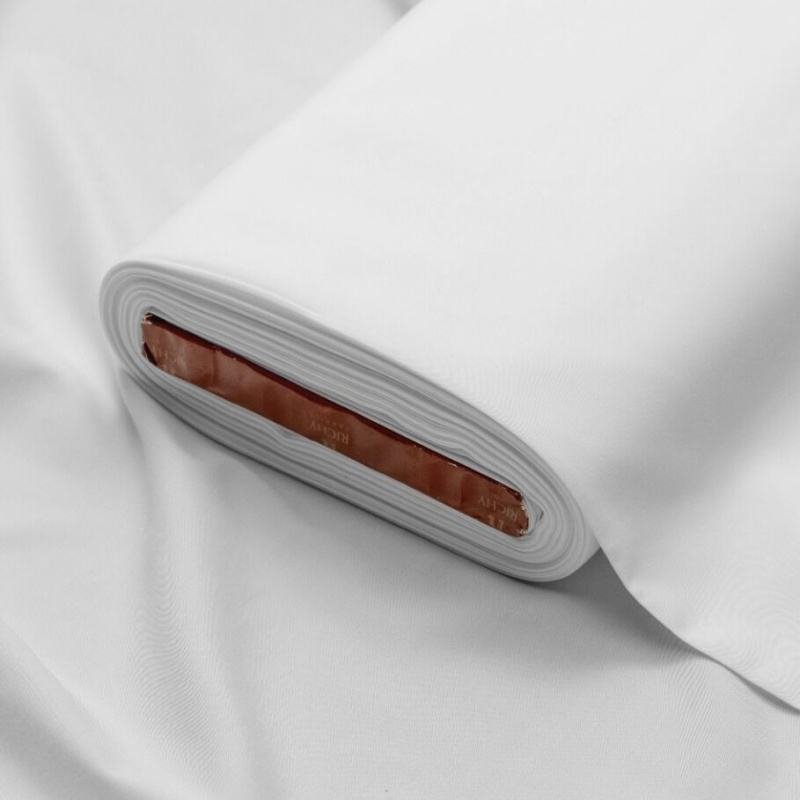
Carton is the default for white and light shades; bales win on volume for dark colours; pallets trade volume for unloading speed.
| Format | Volume per 100 m roll | Protection | Best for | Watch out for |
|---|---|---|---|---|
| Individual carton | 0.19 m³ | High, rigid, labels stay readable | White, ivory, cream, retail-bound wholesale | Costs 0.10 to 0.20 USD per carton |
| Woven bale, 4 to 5 rolls | 0.65 to 0.85 m³ | Medium, needs inner sleeve | Dark navy, black, charcoal, price-driven bulk | Bale straps can mark the outer 2 to 3 m |
| Pallet, 20 to 24 rolls | 1.2 × 1.0 × 1.35 m | High, plus easy handling | Buyers with racking and forklifts | 8 to 12 percent lost volume, plus pallet cost |
| Floor-loaded rolls | 0.13 m³ per roll | Medium | Maximum cube utilisation | Slow unloading, needs a stuffing plan |

For a first order we usually recommend cartons: the buyer gets clean rolls, readable shade lot labels and no arguable surface damage on arrival. From the third or fourth container, dark shades in bales are a sensible saving, provided the inner polythene sleeve is written into the order.
Why Roll Diameter Sets Your Freight Bill
Cutting 4 cm off the packed roll diameter frees more container space than most buyers expect, and it costs nothing but a conversation with the mill.
A 100 m roll of 120 GSM cloth on a 150 cm width is a fixed weight of 18 kg. The volume, however, depends on how tightly it is wound:
- 34 cm diameter — loose winding, roughly 0.16 m³ per roll, 310 rolls in a 40ft HC.
- 32 cm diameter — standard production, roughly 0.14 m³, 330 rolls.
- 30 cm diameter — tight winding on a rigid core, roughly 0.12 m³, up to 360 rolls.
The difference between the first and third row is around 5,000 m of cloth in a single container, which at 0.82 USD per meter is over 4,000 USD of capacity recovered without touching the price of the fabric.
Tight winding has a limit. Push it too far and the cloth develops hard creases along the core line that no steamer fully removes, which on white robe cloth is a visible fault. Ask for 100 m at 30 to 32 cm, not at 28 cm.
What a Landed Cost Looks Like on a 30,000 m Order
Freight, duty and destination charges add 15 to 20 percent to a thobe fabric FOB price, and every one of those lines can be quoted before you place the order.
Worked example, 30,000 m of 135 GSM white polyester in a 40ft HC, Ningbo to Jeddah:
| Cost line | Basis | Per meter |
|---|---|---|
| Fabric FOB | 0.820 USD per meter | 0.820 |
| Ocean freight | 2,200 USD per 40ft HC | 0.073 |
| Marine insurance | 0.5 percent of CIF | 0.005 |
| GCC duty | 6 percent of CIF, confirm HS line | 0.054 |
| Port, clearance and inland | lump sum 600 USD | 0.020 |
| Landed, before bank charges | 0.972 |
Two lines move most. Ocean freight on this route has swung between 1,400 and 3,200 USD per 40ft HC within a single season, so a quote built on today’s rate has a shelf life of about two weeks. Duty depends on the declared HS line and the certificate of origin, which is why the origin document is not paperwork to be sorted out at the last minute.
If you are building a season budget and want the landed figure rather than the FOB figure, send us your target GSM, colour count and monthly volume and we will price it CIF or CFR to your port. Request a quote with your destination port.
Heat, Humidity and Container Rain: Protecting White Thobe Fabric
A four-week sea voyage through the Red Sea in summer exposes white cloth to the two conditions that cause most arrival claims: condensation and phenolic yellowing.
Both are preventable, and both are decided before the container leaves the factory.
- Seal the roll, not just the carton. A polythene sleeve stops the cloth touching craft paper, carton board or any wrapping that carries phenolic antioxidants.
- Hang desiccant, do not lay it. One kilogram per 8 to 10 m³ of container volume, hung from the ceiling lashing rings so moisture is absorbed from the air rather than from contact with the fabric.
- Keep 10 cm off the container floor and walls. Condensation forms on the steel first.
- Load the last cartons short of the doors. The door end is where container rain collects during the temperature swing from Red Sea heat to night cooling.
Requests for a phenolic yellowing result, sometimes called a BHT test, are normal on white and ivory qualities. We run it on every white bulk order, and the background on how yellowing develops is in our guide to white thobe fabric yellowing prevention.
The Documents a GCC Importer Needs With the Container
Five documents travel with a fabric container into the Gulf, and one of them, the conformity certificate, is the one that most often holds up clearance.
| Document | Issued by | Note |
|---|---|---|
| Commercial invoice | Seller | Must match the packing list line by line |
| Packing list | Seller | Roll number, shade lot, meters, gross and net weight |
| Bill of lading | Carrier | Consignee name exactly as registered |
| Certificate of origin | Chamber of commerce | Needed for duty treatment |
| Conformity certificate | SABER SCoC for Saudi, ECAS for UAE | Per shipment, not per year |
The Saudi route is covered in more depth in our guide to importing thobe fabric into Saudi Arabia, including what a SABER account can and cannot do for a buyer who is not the registered importer.
One practical note: the meters declared on the packing list are usually checked against the invoice at destination. A 1 percent tolerance written into the PO protects both sides from an argument about a 240 m difference on a 24,000 m shipment.
How to Write Packing Instructions Into the PO
Six lines in the purchase order prevent almost every packing dispute we have seen in ten years of GCC shipments.
- Roll length and tolerance — 100 m plus or minus 1 percent, minimum roll 30 m, no more than 5 percent of rolls below 80 m.
- Roll diameter and core — 30 to 32 cm packed, rigid core board, no crushed cores.
- Inner packing — polythene sleeve plus craft paper on white and light shades.
- Outer packing and label — carton, with roll number, shade lot, meters, GSM, gross and net weight printed on the outside.
- Pallet and stack height — pallet dimensions if required, maximum stack of four cartons.
- Desiccant — 1 kg per 8 to 10 m³, hung, with the quantity stated on the packing list.
Those six lines take a buyer fifteen minutes to write and save weeks of correspondence later. They also make final inspection meaningful, because the inspector has something objective to check against; our pre-shipment quality checks guide sets out how the roll report ties into that.
Five Mistakes That Cost Buyers Money on Bulk Shipments
Most bulk thobe fabric losses are avoidable administrative errors rather than manufacturing faults.
- Comparing FOB only. Two suppliers 3 cents apart on FOB can be 8 cents apart landed once packing density and freight are included.
- Ignoring roll diameter in the quote. A loose-wound roll can cost 5,000 m of container capacity.
- Bales without an inner sleeve. Strap marks on the outer three meters are a claim waiting to happen.
- One shade lot for a multi-colour order. Splitting dye lots across a container is fine, but each lot needs its own label and its own roll report.
- Booking freight before the cloth is inspected. A container that sails with an uninspected lot cannot be fixed at destination.

If you are comparing several mills before committing a container, our bulk thobe fabric supplier shortlist method sets out the questions that separate a mill from a trader, and a 3 m roll-end sample from any candidate quality is worth more than a page of specifications.
For buyers planning quantities across a season rather than a single shipment, message us on WhatsApp from the contact page with your monthly volume and delivery port, and we will return a stuffing plan, a shade lot schedule and a CIF figure you can budget against.
Frequently Asked Questions
How many meters of bulk thobe fabric fit in a 40ft container?
On 120 to 135 GSM thobe cloth at 150 cm width, packed as 100 m rolls in individual cartons, a 40ft high cube takes roughly 300 to 330 cartons, which is 30,000 to 33,000 m. A 20ft general purpose container takes about 130 to 150 cartons, or 13,000 to 15,000 m. The limiting factor is volume, not weight: 300 rolls at 18 kg each is only 5.4 tonnes against a payload capacity above 25 tonnes, so the container cubes out long before it weighs out. Thinner summer qualities at 100 to 110 GSM load slightly more meters per container, while 160 GSM formal qualities load fewer.
Should bulk thobe fabric be packed in cartons, bales or on pallets?
Cartons protect the roll surface and the shade lot label and are the default for white and light colours going to Gulf retail customers. Woven bales cost less per cubic meter and are common for dark colours and price-sensitive wholesale, but the cloth needs an inner polythene sleeve because bale straps mark the outer layers. Pallets add a footprint and roughly 8 to 12 percent lost volume, yet they cut unloading time at the destination warehouse and are worth it when the buyer has no forklift-free space. Mixed packing, pallet for the first order and bales for repeat bulk, is normal practice.
Why is thobe fabric freight volume-limited rather than weight-limited?
Because the cloth is light for its bulk. At 120 GSM and 150 cm width, a 100 m roll weighs only 18 kg but occupies about 0.13 cubic meters, so one cubic meter of cargo weighs under 140 kg while a container can legally carry 25 tonnes or more. Freight therefore scales with roll diameter and packing density, not with tonnage. Reducing roll diameter from 34 cm to 30 cm, or floor-loading instead of palletizing, saves more money than any negotiation on the ocean rate. Ask your supplier for the packed roll diameter before you compare freight quotes.
How do I calculate landed cost on a bulk thobe fabric order?
Start from the FOB price per meter, then add freight per meter, insurance, GCC duty and destination charges. As a worked example on 30,000 m at USD 0.82 FOB in a 40ft high cube: ocean freight of USD 2,200 adds about 0.073 per meter, insurance adds 0.005, duty at 6 percent of CIF adds about 0.054, and port plus inland delivery adds 0.02, giving roughly USD 0.97 per meter landed before customs clearance fees. Buyers who compare only FOB prices miss that freight and duty together can move the effective cost by 15 to 20 percent.
What packing details should be written into a thobe fabric purchase order?
Six lines stop most disputes. Specify roll length and tolerance, for example 100 m plus or minus 1 percent, with a minimum roll of 30 m. Specify roll diameter and core board. Specify the inner packing, polythene sleeve plus craft paper for white cloth. Specify the outer packing, carton with roll number, shade lot, gross and net weight, meters and GSM printed on the label. Specify pallet dimensions and maximum stack height if pallets are required. Finally specify the desiccant quantity and that bags are hung rather than laid on the cloth. A packing list matching those lines should travel with the shipping documents.
How do I protect white thobe fabric from yellowing during a long sea voyage?
White polyester is vulnerable to phenolic yellowing when it sits in a hot, humid container for three to four weeks. Three measures reduce the risk: keep the cloth in a sealed polythene sleeve so it never touches untreated board or PVC, hang one kilogram of desiccant per eight to ten cubic meters of container volume instead of laying bags on the rolls, and request a BHT or phenolic yellowing test result with the shipment. Buyers receiving in Jeddah or Dammam in summer should also ask for a container with a good roof and avoid stacking cartons against the doors, where condensation is heaviest.