The Short Answer: How Long Does Thobe Fabric Last?
Thobe fabric lasts between 40 and 150 domestic wash cycles depending on grade — an entry-level 110 GSM soft-finish polyester starts to show wear at about wash 40, a 140 GSM micro-polyester holds past 80, and a 180 GSM poly-viscose TR twill or a yarn-dyed construction passes 100 before structure or shade fails.
In service terms that is roughly 18 months of regular wear on the cheapest quality and three to four years on the middle grades, provided the garment is washed at 30 °C and air dried.
We have exported thobe, kandura and djellaba fabric into the Gulf for more than ten years, and the complaints that come back to us are remarkably consistent. They are about whiteness, about the collar and cuff edge, about a tear that opened along a seam, and about one delivery that did not match the last one — almost never about the fibre name on the specification sheet.
What Actually Ends a Thobe’s Life
A thobe fails at one of four points, and every one of them has a test method that predicts it before the fabric leaves the mill.
The four failure modes, in the order they appear on real garments:
- Whiteness loss. Optical brightener washes out and residual heat or alkali leaves a yellow cast. Nothing has torn; the garment simply looks old.
- Surface abrasion. Collar edge, cuff edge, underarm and bottom hem thin out first because those are the contact points.
- Tear failure in easy-care cloth. A resin finish that stops cotton creasing also cuts tear strength, and the drop is invisible on the roll.
- Shade drift between lots. Two dyeings of the same shade that were never matched to the same standard become two different thobes on the same shelf.
Everything a buyer can do about service life happens at one of those four points, either in the specification or in the care label.

Service Life by Grade: What to Expect
Grade, not fibre name, decides service life — the spread between the cheapest and the best thobe quality is roughly a factor of three.
| Quality | GSM band | Indicative FOB price | Expected wash cycles | Typical limiting factor |
|---|---|---|---|---|
| Entry soft-finish polyester, plain | 110–125 | $0.76–1.05/m | 40–60 | Whiteness loss, weft streakiness |
| Standard polyester, heat set | 130–140 | $1.00–1.25/m | 60–80 | Collar and cuff abrasion |
| Micro-polyester, heat set, compact | 140–160 | $1.15–1.55/m | 80–110 | Abrasion at hem, seam slippage |
| Poly-viscose TR twill | 150–180 | $1.20–1.80/m | 70–100 | Tear strength, viscose content fading |
| Resin-finished easy-care cotton (TC) | 130–160 | $1.30–2.10/m | 50–80 | Crease recovery drops 20–40% by wash 50 |
| Yarn-dyed dobby or jacquard | 160–220 | $2.40–5.00/m | 100–150 | Colour contrast softening, not failure |
The table is a planning tool, not a guarantee. A 140 GSM quality washed at 60 °C in a tunnel finisher will not outlast a 120 GSM quality washed at 30 °C and hung to dry, because the wash regime moves the number more than one step of grade does.
The Laboratory Numbers Behind These Ranges
If a supplier cannot name the test method behind a durability claim, the claim is marketing rather than specification.
These are the tests we run on thobe qualities and the values a serious programme should be able to hold:
| Property | Test method | Target for quality thobe fabric | What it predicts |
|---|---|---|---|
| Abrasion resistance | ISO 12947-2, 12 kPa | 25,000–40,000 cycles to end-point | Collar and cuff wear-out |
| Tensile strength | ISO 13934-1 (strip) | Warp 450–700 N at 130–160 GSM | Seam and placket failure |
| Tear strength | ISO 13937-2 (Elmendorf) | Warp 15–30 N; ≥15 N on easy-care | Tear propagation in resin cloth |
| Dimensional stability | ISO 6330, 3 and 5 cycles | ≤2% warp, ≤2% weft, white qualities | Width creep, hem distortion |
| Colour fastness to washing | ISO 105-C06 | Grade 4 change, 3–4 staining | Shade after repeated laundering |
| Colour fastness to light | ISO 105-B02 | Grade 5–6 for white, 4–5 for colour | Fading on the rack and in wear |
| Whiteness retention | CIE whiteness after 50 cycles | ≥125 CIE, L* ≥91 | The “it looks old” complaint |
| Seam slippage | ISO 13936-2 | ≥6 mm at 180 N | Side seam opening |
Two of these kill more deliveries than the rest. Dimensional stability decides whether a thobe still hangs correctly after a season, and whiteness retention decides whether the customer believes it. A white thobe that has lost 15 CIE points reads as grey beside a new one, even though the fabric is physically intact.
Whiteness Is the Number Buyers Under-Specify
Whiteness retention is the single most useful durability figure for a white thobe programme, and it is the one most often left out of the purchase order.
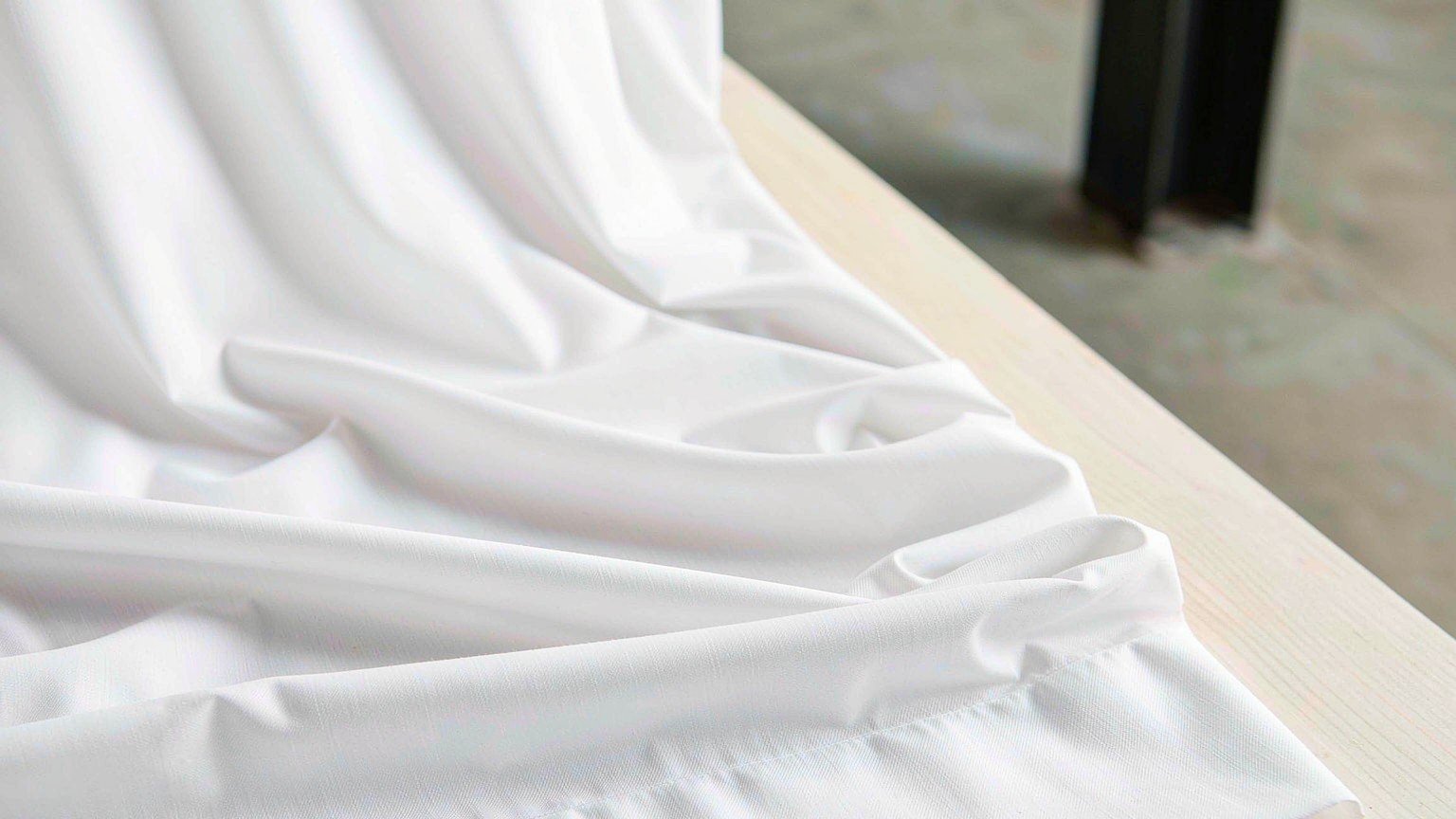
Fresh optic-white thobe fabric usually lands above 140 CIE with L* at or above 93. What matters is what survives. A correctly heat-set micro-polyester we test holds above 125 CIE after 50 ISO 6330 cycles with a colour difference under 2.0 against the retained standard. An entry quality with a heavy brightener loading but no heat setting can fall below 110 CIE in the same test, and the drop is not linear — most of it happens in the first 20 washes.
Three causes account for most whiteness complaints we investigate:
- Brightener loss rather than fibre damage. Optical brightening agents are surface chemistry. They wash out, and no amount of fabric care brings them back.
- Alkali and heat residue. Incomplete neutralisation after scouring and a hot, dry press combine into a permanent yellow cast that appears after the second or third wash.
- Packaging and storage. Polyethylene film over fabric stored above 65 percent relative humidity traps moisture and produces the same cast in weeks rather than months.
That is why we quote whiteness as a value at delivery and as a value after 50 cycles, and why the storage rules in our store thobe fabric guide are part of the specification conversation rather than a footnote.
Why the Same Fabric Lasts Twice as Long for One Buyer
Service life is decided about 60 percent by the fabric and 40 percent by what happens to the garment afterwards.
The levers, ranked by how much difference they make:
- Wash temperature. Every step from 30 °C to 60 °C costs service life. A Gulf industrial laundry running tunnel washers at 70 to 80 °C for uniform programmes will halve the life of a fabric that a household machine at 30 °C would keep for years.
- Drying method. Tumble drying abrades fibre ends and shrinks width. Air drying in shade preserves both, and it costs nothing.
- Ironing contact. Polyester glazes permanently above roughly 160 °C, and TR above 180 °C. Steam and movement beat pressure and dwell time.
- Detergent chemistry. Chlorine bleach attacks the fibre, not just the dye. On white thobe qualities it is the fastest route to a yellow cast in hard-water regions.
- Rotation and storage. Garments worn on alternate days recover their shape between wears, and fabric stored dry and ventilated keeps its whiteness.
A buyer who cannot control how the end customer launders a thobe can still control the care label, and the care label is what a complaint gets judged against. Our thobe fabric care guide sets out the wash, dry, press and store wording we recommend for polyester, TR and cotton-rich qualities.
What to Write Into the Purchase Order
Eight lines convert “durable thobe fabric” from an adjective into something a supplier can be held to.
| PO line | Recommended wording |
|---|---|
| Weight | 140 GSM ±3% measured to ISO 3801 |
| Dimensional stability | Max 2% warp / 2% weft after 3 ISO 6330 cycles at 40 °C |
| Whiteness | CIE ≥130 at delivery; ≥125 after 50 ISO 6330 cycles |
| Colour fastness | ISO 105-C06 grade 4 change, 3–4 staining; ISO 105-B02 grade 5–6 |
| Abrasion | ISO 12947-2, ≥25,000 cycles |
| Tear strength | ISO 13937-2 warp ≥15 N |
| Lot consistency | ΔE ≤1.0 between lots, ≤0.8 within a lot |
| Care label | Wording per ISO 3758, included in the pre-shipment sample |
Two clauses do more work than the rest. The lot-consistency figure prevents the shade-drift complaint that arrives six months later, and the care-label line makes the wash instructions part of the delivered product rather than the buyer’s problem after shipping.
Cost per Wear: When the Cheap Fabric Is the Expensive One
Fabric price per metre says very little about what a thobe costs to own, because cheap cloth is replaced sooner.
Take a men’s thobe using 3.8 metres of fabric, with a two-year ownership horizon:
| Grade | Fabric cost per thobe | Expected service life | Cost per wear |
|---|---|---|---|
| Entry polyester at $0.85/m | $3.23 | 40 washes | $0.081 |
| Standard polyester at $1.15/m | $4.37 | 70 washes | $0.062 |
| Micro-polyester at $1.40/m | $5.32 | 95 washes | $0.056 |
| TR twill at $1.60/m | $6.08 | 85 washes | $0.072 |
The gap between entry and mid-grade fabric is under $2.10 per garment, while the cost per wear falls by roughly a third. For a retailer or tailoring chain, that arithmetic is what justifies moving an order up one grade — and it is also why we ask buyers what wash regime their end customers use before recommending a quality.
The wider price ladder, including how the tiers differ in construction rather than only in weight, is set out in our thobe fabric price per metre comparison.
Two Programmes, Two Outcomes
Both of these started with the same fabric price. What separated them was the specification line for whiteness and stability.
A tailoring chain in Jeddah began with a 115 GSM entry polyester because the price per metre was the lowest on offer, and ran it for three seasons. Complaints after 18 months were almost entirely about colour: customers returning thobes that had gone dull beside a new purchase. The chain moved to a 140 GSM micro-polyester heat set under tension with a whiteness floor written into the order, absorbed an increase of about 22 percent on fabric cost, and the return rate on white garments fell sharply within two seasons — because the failure point moved from wash 35 to beyond wash 80.
A Dubai importer took the opposite route and kept the entry quality but tightened process instead: 30 °C wash recommendation on the care label, chlorine-free detergent, no tumble drying, and warehouse humidity monitoring below 65 percent. Returns on that programme dropped by more than half without a single change to the fabric. Both outcomes came from writing down which failure mode the programme was trying to avoid.
A third buyer, an Abu Dhabi uniform supplier running industrial laundry at 70 °C, could not use either route and moved to a 170 GSM TR twill rated for higher-temperature washing. That is the honest answer when the laundry regime is fixed: choose the fabric that tolerates the process rather than the process that flatters the fabric.
Questions to Ask Before the Bulk Run
Five answers separate a supplier with a durability position from one that only has a product list.
- What whiteness value do you guarantee at delivery, and what is it after 50 ISO 6330 cycles? Two numbers, not one.
- At what temperature is the fabric heat set, and how is width controlled? Heat setting under tension is what makes the width promise achievable.
- What abrasion result does this quality reach on ISO 12947-2, and at what pressure? A cycle count without the test pressure means nothing.
- What is your cross-lot colour tolerance, and which instrument measures it? Ask for ΔE, and ask which standard the lots were matched to.
- Will you supply a retained swatch from this production lot? It is the only way to settle a complaint a year later.
Buyers who want the acceptance side in more depth will find our pre-bulk quality checklist useful, because durability and acceptance use the same laboratory evidence.
We weave, dye and finish thobe fabric in polyester, micro-polyester, poly-viscose TR, dobby and jacquard under one roof in China, and we test every quality for whiteness retention, dimensional stability and abrasion before it ships. Send us your GSM band, colour count, target service life and the wash regime your end customers use through our contact form or WhatsApp, and we will come back with a recommended quality, the test values we can hold on it, the price per metre from $0.76 FOB and the MOQ per colour — including a 500-metre trial run so you can wash-test the fabric before you commit a season to it.
Frequently Asked Questions
How long does thobe fabric last in washes and in years?
Entry-level 110 to 125 GSM soft-finish polyester reaches the end of its useful life at roughly 40 domestic wash cycles, a 130 to 150 GSM micro-polyester typically holds to 80 or more, and a 150 to 180 GSM poly-viscose TR twill or a yarn-dyed dobby runs past 100 cycles before structure or shade fails. In service terms, a thobe worn daily and laundered twice a week lasts about 18 months on the entry grade and three to four years on a mid or upper grade, provided it is washed at 30 degrees Celsius and air dried. The number that changes the answer fastest is not the fibre but the wash regime: a 60 degree industrial wash can cut service life by 30 to 40 percent on the same fabric.
What are the first signs that thobe fabric is wearing out?
Whiteness loss appears first, usually between wash 20 and wash 30, and shows as a duller, slightly grey or yellow cast under daylight rather than a stain. Abrasion follows at the collar edge, cuff edge, underarm and the bottom hem, where the cloth rubs against skin and furniture. Tear strength is the third signal and the least visible: resin-finished easy-care cotton can lose 20 to 40 percent of its tear resistance over 50 washes while the surface still looks intact. Seam slippage at the side seam and collar interlining collapse are the last stage. Ask for a laboratory report on whiteness retention and tear strength after 50 ISO 6330 cycles, not a description of how the fabric feels on the roll.
Does a higher GSM always mean a longer-lasting thobe?
No. Weight helps, but construction and finish matter more above 130 GSM. A 160 GSM plain weave with a heavy softener and no dimensional control outlives nothing, because it creeps in width after five washes and starts showing weft streakiness. A 140 GSM micro-polyester that has been heat set under tension holds its width within two percent through 50 washes and keeps its whiteness above 125 CIE. For buyers, the useful rule is to treat GSM as one line of the specification alongside heat-setting temperature, dimensional tolerance, whiteness target and tear strength, and to refuse a quotation that names only the weight.
How should thobe fabric be washed to protect a two-year claim?
Wash at 30 degrees Celsius on a gentle cycle with a mild detergent, avoid chlorine bleach entirely, and skip fabric softener on white qualities because the residues yellow under heat. Keep the load below three quarters of the drum, since friction is what abrades collar and cuff edges. Air dry in shade rather than tumble drying, and press at 110 to 130 degrees Celsius for polyester and 140 to 160 for TR, moving the iron rather than holding it still. Whites should be washed separately from coloured thobes and stored below 65 percent relative humidity. Those five habits add roughly 30 to 50 percent to the service life of the same fabric.
Why does the same thobe fabric last longer for one buyer than another?
The three variables with the largest effect are wash temperature, drying method and ironing contact time. A programme washing at 60 degrees Celsius with a tunnel finisher at 180 degrees loses 30 to 40 percent of its service life compared with a 30 degree wash and air drying of identical cloth. Storage matters second: white thobe fabric packed in polyethylene with residual moisture yellows within a season, even if the fabric itself tested well. Pressing matters third, because a stationary iron above 160 degrees on polyester creates a permanent shine that no wash removes. Buyers who write wash temperature, drying method and pressing range into the care label, and ask their customers to follow it, recover most of the difference.