Store thobe fabric dark, dry and acid-free — 15–25 °C, 45–60% relative humidity, wrapped in acid-free film, standing on shelves at least 30 cm off the floor — and white cloth holds its whiteness for 12 to 24 months depending on fibre. The yellowing that buyers blame on the mill is usually caused after the goods leave the mill, in a humid or sunlit warehouse.
We have shipped white thobe, kandura and djellaba fabric into the Gulf for more than ten years, and we handle more claims about stored cloth than about cloth in transit. Almost every one traces back to four storage variables that cost nothing to control and are almost never written into a warehouse procedure.
The Short Answer: How to Store Thobe Fabric
Four controls prevent stored white thobe fabric from yellowing: darkness, moderate humidity, acid-free wrapping and separation from the floor and exterior walls.
| Control | Target | Why it matters |
|---|---|---|
| Light | Dark storage, no UV | Ultraviolet light oxidises fibre and destroys optical brighteners |
| Temperature | 15–25 °C, stable | Heat accelerates oxidation and moisture migration |
| Relative humidity | 45–60% | Above 65% encourages mould and alkali migration; below 40% embrittles cotton |
| Wrapping | Acid-free tissue or polyethylene film | Kraft, cardboard and untreated wood release acid vapours |
| Position | 30 cm off floor, 10 cm off exterior wall | Floor and wall contact transfers moisture and condensation |
| Stack height | Four rolls maximum, upright | Prevents flat spots and permanent set |
Hold those six and the cloth is stable. Miss the humidity and the wrapping, and a roll that left the mill at a CIE whiteness above 140 can be visibly off-shade within one Gulf summer.
Why Stored White Fabric Turns Yellow
Yellowing in storage is a chemistry problem with four distinct routes, and only one of them happens at the mill.
- Residual alkali from finishing. Mercerising, scouring and some softeners leave alkali in the cloth. In dry conditions it stays bound; in humid conditions it migrates and oxidises the fibre surface into a yellow cast.
- Oxidation under light and oxygen. Polyester and cellulose both oxidise slowly. UV accelerates the reaction by an order of magnitude, which is why a sunlit warehouse wall produces a shade difference between the outer and inner layers of the same pallet.
- Optical brightener migration. The brightening agents that make white cloth read bright are mobile molecules. Under heat and moisture they migrate, redistribute unevenly and can degrade into a yellow-tinted compound.
- Airborne acid. Kraft paper, cardboard, untreated timber, diesel exhaust and cleaning chemicals all release acidic or sulphur-bearing compounds that attack the same brighteners.
The fix for the first three is environmental. The fix for the fourth is a barrier layer between the fabric and its packaging.
The Storage Environment, in Numbers
Treat these as warehouse specifications rather than ideals: if your facility cannot hold the first two rows, no packing method will save the roll.
| Parameter | Recommended | Failure mode if exceeded |
|---|---|---|
| Temperature | 15–25 °C, stable, no daily swing above 8 °C | Condensation on cold rolls in a humid room |
| Relative humidity | 45–60% | Mould above 70%; brittleness and static below 40% |
| Light | Dark, or dim with no direct sun | Shade variation across a pallet |
| Air quality | No diesel exhaust, no solvent or ammonia fumes | Localised yellow patches |
| Floor clearance | ≥30 cm | Wicking and condensation transfer |
| Wall clearance | ≥10 cm from exterior walls | Seasonal condensation transfer |
A humidity meter and a thermometer cost less than one rejected roll. We have seen warehouses in Jeddah and Dammam where the daily humidity swing alone ranged from 35% to 78% within the same building, which explains why parts of a consignment aged faster than others.
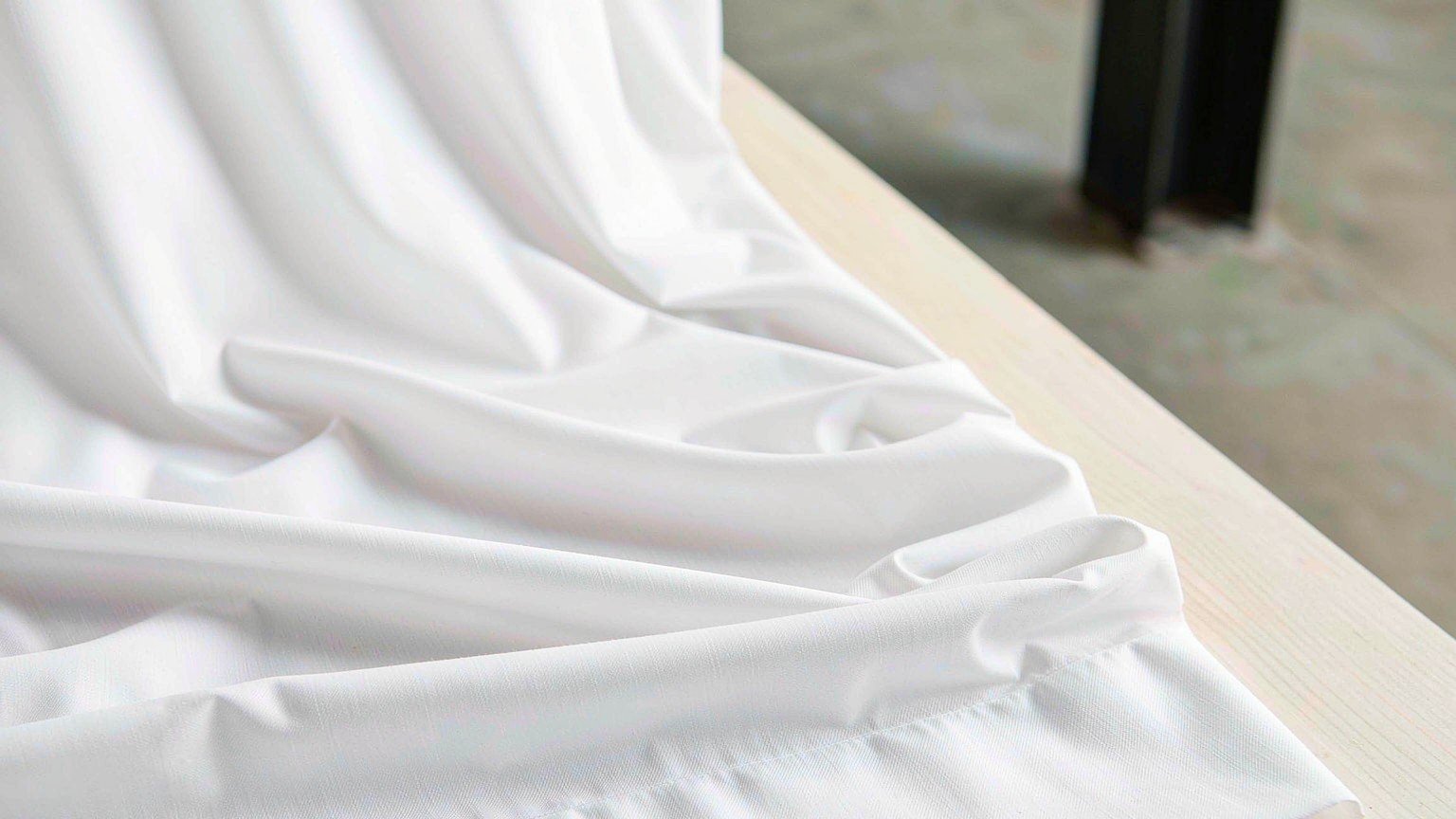
Wrapping and Stacking a Roll
The wrapping is a barrier, and the stacking is a geometry problem: get both right and the roll comes off the shelf as flat and as bright as it went on.
For roll goods:
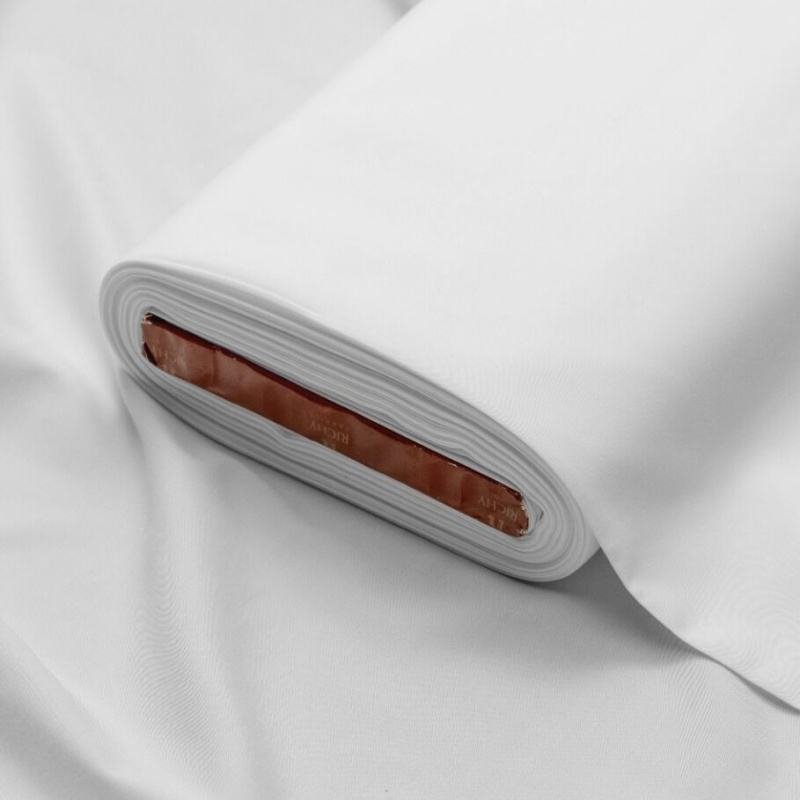
- Wrap in a polyethylene film of at least 60 microns, or in acid-free tissue inside a sealed poly bag. Avoid PVC film entirely; it releases plasticiser over time.
- Include a desiccant sachet in long-term storage where humidity cannot be controlled. Replace it every six months.
- Stand rolls upright on end. Where the rack only allows flat storage, keep stacks to four rolls and place a rigid board between layers.
- Never stack rolls directly against a sunlit wall or under a skylight. A pallet against a window wall develops a shade gradient across its width.
- Label each roll with the production lot, date, GSM and shade reference, so a whiteness check years later can be compared against the retained standard.
For cut panels and bundles in a garment factory, the priorities change: the cloth is already exposed on all faces, so use sealed poly bags, store flat without compression, and cut within a shorter window — 4 to 8 weeks is the sensible target for white panels.
Storage Life by Fibre and Finish
The more absorbent and the more chemically finished the cloth, the shorter its safe storage window.
| Quality | Storage life, controlled conditions | Notes |
|---|---|---|
| 100% polyester, heat-set | 24 months | Most stable; resists moisture uptake |
| TR 65/35, heat-set | 18 months | Slight moisture sensitivity from the viscose content |
| Poly-cotton TC 65/35 | 12–15 months | Absorbs moisture; check whiteness at 12 months |
| Cotton-rich or 100% cotton | 6–12 months | Highest moisture uptake; store sealed |
| Resin-finished wrinkle-free | 6–12 months | Finish can continue to cure; residual formaldehyde risk |
| Recycled polyester (rPET) | 18–24 months | Baseline whiteness starts 8–14 CIE points lower than virgin |
Those windows assume the environment table above is respected. In an uncontrolled warehouse, cut every figure by roughly half and re-test before use. A wrinkle-free finish deserves particular attention because the resin is the same chemistry that drives formaldehyde results, and the limits are 20 ppm for children’s wear and 75 ppm for direct skin contact under the SASO textile regulation.
Checks Before the Fabric Reaches the Cutting Table
Four checks take twenty minutes and catch almost every storage problem before it becomes a garment problem.
- Whiteness against the retained standard. Spread a two-meter length in daylight, grade against the standard from the same lot. Within half a CIE point is acceptable; a full point or more means the batch should be reviewed with your supplier before cutting.
- Width at three points. Storage that involves compression can narrow a roll by a centimetre at the edges.
- Weight check. Cut a 30 × 30 cm square, condition it in standard atmosphere for four hours and weigh it. A GSM that reads high almost always means absorbed moisture rather than a heavier weave.
- Set marks. Hang two meters freely for 24 hours and inspect for flat spots along the length.
For a batch that has already drifted, mild yellowing is sometimes recoverable with a controlled re-wash and a fresh optical brightener treatment, but the whiteness rarely returns to the original value and the process costs more than the storage controls that would have prevented it. Our guide to preventing yellowing in white thobe fabric sets out the causes in order of frequency and the thresholds we hold in production.
Sample Libraries and Swatch Books
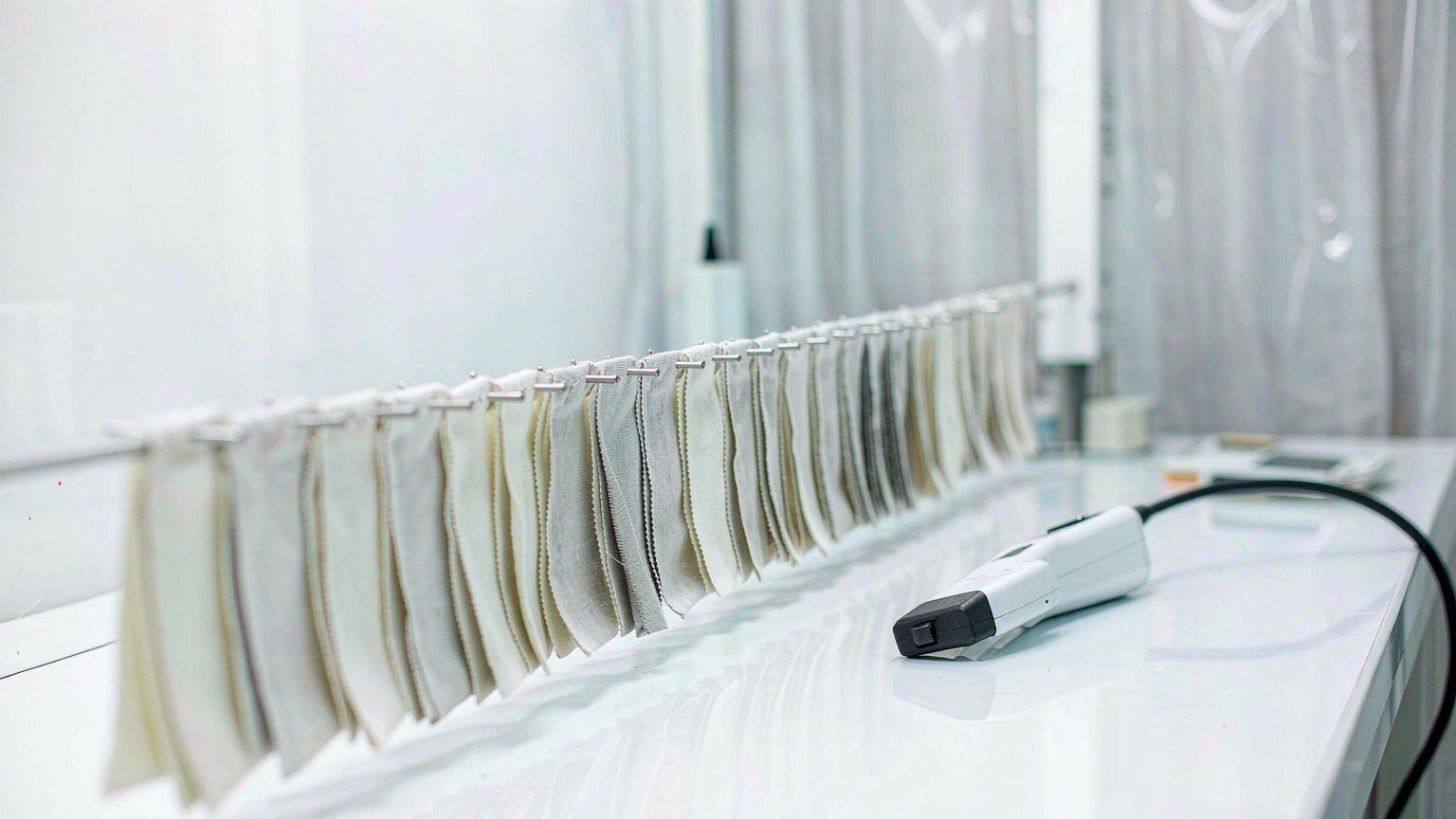
Swatch books decay faster than roll goods because they are handled, exposed and usually stored in a room with a window.
Keep the reference library in a closed drawer, not on an open wall. Replace master standards every 12 months and keep the old standard labelled rather than discarding it, so a claim two years later can be traced. Where a colour has to be matched across repeat orders, hold a retained standard of at least 30 × 30 cm from each bulk lot; a 5 cm swatch is too small to judge a shade difference reliably.
Buying Fabric You Can Store
Ask for the whiteness value, the finishing route and a retained standard with the shipment, then store it as if the whiteness were a perishable asset — because commercially, it is.
We ship white thobe fabric with a declared whiteness value, a lot number and a retained reference sample, and we will quote storage and packing options that suit your warehouse rather than ours. If you are planning a season’s volume and want the fabric packed for long storage, tell us the storage duration when you enquire. You can request a quotation and a swatch pack here, or send us your GSM, width and colour requirements directly and we will come back with a lot plan that includes the storage advice for your climate.
Frequently Asked Questions
How should I store white thobe fabric to stop it turning yellow?
Store white thobe fabric in the dark, at 15 to 25 degrees Celsius and 45 to 60 percent relative humidity, wrapped in an acid-free film, on shelving at least 30 centimeters off the floor and away from exterior walls. The four causes of yellowing in stored white cloth are residual alkali from finishing, oxidation of the fibre under light and oxygen, migration of optical brighteners, and airborne acid from cardboard, wood or exhaust fumes. Dark and dry addresses the first three; acid-free wrapping and a barrier against the packaging address the fourth. A roll stored correctly holds its CIE whiteness well past twelve months, while the same roll in a humid, sunlit warehouse can shift within a single season.
How long can thobe fabric be stored before cutting?
Storage life depends on fibre and finish rather than on the roll. A 100 percent polyester white thobe fabric held in the conditions above keeps its whiteness and dimensional stability for roughly 24 months. A TR blend holds about 18 months, a poly-cotton TC blend 12 to 15 months, and a cotton-rich or resin-finished quality 6 to 12 months, because resin finishes can continue to cure and cotton absorbs atmospheric moisture. Any quality that has been sanforised holds its dimensions better than an unshrunk one. Beyond those windows the fabric is still usable but should be re-tested for whiteness and shrinkage before it goes to the cutting table.
Does stacking fabric rolls cause creases or deformation?
Yes, if the stack is too high or the rolls are stored flat rather than standing. Woven thobe fabric has a degree of memory: a roll left flat under weight for months takes a set that shows up as flat spots and fold lines along the length. Stand rolls upright on end wherever the rack allows, keep stacks to four rolls high, and place a rigid board between layers. If a roll has been stored flat and shows a set, hang it freely for 24 hours at room temperature before spreading; the weave relaxes and most surface marks lift without any further treatment.
Can I store fabric in a cardboard box or a wooden crate?
Not directly against the cloth. Kraft paper, cardboard and untreated wood release acidic compounds as they age and in the presence of moisture, and those acids attack the optical brighteners that make white thobe fabric read as bright. The standard fix is a barrier: wrap the roll in acid-free tissue or a polyethylene film first, then box it. If you are shipping or storing long term, a polyethylene-lined carton is the safer choice, and never store fabric in a container that has previously held food, chemicals or cleaning agents.
What should I check before cutting fabric that has been stored?
Run four checks. First, spread a two-meter length in daylight and grade the whiteness against a retained standard from the same production lot. Second, measure the width at three points along the roll. Third, cut a 30 by 30 centimeter square, condition it at standard atmosphere and measure the weight to confirm GSM has not drifted through moisture uptake. Fourth, hang a two-meter length freely for 24 hours and look for set marks. If the whiteness is within half a CIE point of the standard and the width is inside tolerance, the roll is ready for the cutting table without further treatment.